

International Relocation Guide: Choosing Overseas Moving Companies
Learn how to choose a reliable overseas moving company, manage customs, and protect your belongings in this international relocation guide.

By Megan Hall
Moving to another country is one of the most significant decisions a person can make. It involves not only packing up a household but also navigating customs regulations, shipping timelines, and a completely new environment. The difference between a smooth international move and a stressful one often comes down to one critical choice: the overseas moving company you hire. This overseas moving companies international relocation guide will walk you through the essential steps to select a reliable partner, prepare your belongings for a long journey, and avoid common pitfalls that can derail your plans.
An overseas move is not simply a longer version of a domestic move. It requires coordination between freight forwarders, customs brokers, and shipping lines, often across multiple time zones. A professional overseas moving company handles these logistics on your behalf, but you still need to understand the process to ask the right questions and make informed decisions. This guide covers everything from initial estimates to final delivery, with practical advice you can use immediately. Whether you are relocating for work, family, or adventure, the information below will help you approach the process with confidence.
Why Hiring a Specialized Overseas Moving Company Matters
When you move overseas, your belongings will travel by sea or air, which means they will be handled by multiple parties before reaching your new home. A specialized overseas moving company has the experience to manage these handoffs, ensuring that your items are properly packed, documented, and tracked. They understand the paperwork requirements for different countries and can advise you on what can and cannot be shipped. Without this expertise, you risk delays, damaged goods, or even confiscation of prohibited items at customs.
Moreover, a reputable overseas moving company offers insurance options that protect your belongings during transit. Standard coverage may only provide minimal compensation, so you should understand the difference between released value and full replacement value. A good mover will explain these options clearly and help you choose the level of protection that fits your needs. They also provide a single point of contact, so you are not chasing down separate trucking companies, port agents, or customs brokers yourself. This coordination is invaluable when you are also trying to settle into a new job or find a place to live.
Key Services to Expect from an International Mover
The scope of services offered by international moving companies can vary significantly. Some provide only basic transportation, while others offer a full-service experience that includes packing, customs clearance, and even unpacking at your destination. When comparing providers, look for the following services that can make your move easier and safer:
- Pre-move survey: A virtual or in-person survey to assess the volume and weight of your shipment.
- Export packing: Professional packing using materials designed for ocean or air transit, such as corrugated boxes, shrink wrap, and custom crates.
- Customs documentation: Preparation and submission of required forms, including inventory lists and certificates of origin.
- Door-to-door delivery: Coordination of pickup, freight, and final delivery to your new address, including possible internal delivery.
- Storage options: Short-term or long-term storage if your new home is not ready or if you need to consolidate shipments.
These services are not just conveniences; they are essential for protecting your belongings and ensuring compliance with international shipping laws. For instance, export packing uses materials that protect against moisture, impact, and temperature changes during a long sea voyage. A mover that only offers basic loading and unloading may not have the expertise to handle fragile or high-value items that require custom crating. Always ask for a detailed list of what is included in the quoted price, so you can compare apples to apples.
Additionally, some movers offer special services for items like art, antiques, pianos, or vehicles. If you have such items, confirm that the mover has experience with them and can provide the necessary packaging and insurance. In our guide on choosing global relocation companies for international moves, we discuss how to evaluate these specialized capabilities. Taking the time to verify these details upfront can prevent costly surprises later.
How to Get Accurate International Moving Quotes
Getting accurate quotes is one of the most challenging parts of planning an international move. Unlike domestic moves, where you pay by the hour, international moves are usually quoted based on the volume or weight of your shipment. This means you need an accurate estimate of what you are taking with you. Most reputable movers will conduct a detailed survey, either virtually or in person, to calculate the cubic feet or kilograms of your household goods. Avoid companies that give you a quote over the phone without asking about your specific items, as this often leads to lowball estimates that increase later.
When you receive quotes, compare them carefully. The lowest price may not be the best deal if it excludes essential services like packing or customs clearance. Ask for a breakdown of costs, including ocean freight, fuel surcharges, port fees, and destination charges. Also, clarify the payment terms. Some movers require a deposit upfront, while others ask for full payment before the shipment arrives. Be wary of any company that demands a large deposit before providing a written contract.
Another factor that affects cost is the mode of transport. Sea freight is the most economical option for large households, but it can take several weeks or even months. Air freight is much faster but significantly more expensive, making it ideal for small shipments or urgent items. Your mover should explain these trade-offs and help you choose the best option for your timeline and budget. Remember that the quote is just the starting point; the final cost can increase if you add items or change the delivery address, so keep communication open.
Customs Regulations and Documentation: What You Need to Know
Every country has its own customs regulations, and the consequences of non-compliance can be severe, including fines, delays, or seizure of your goods. A professional overseas moving company knows the requirements for your destination country and will help you prepare the necessary documentation. This typically includes a detailed inventory of your belongings, a valid passport or visa, proof of residence abroad, and sometimes a certificate of non-residency to prove that you are relocating. Your mover should provide a checklist of documents well in advance of the move date.
Additionally, certain items are restricted or prohibited in many countries, such as plants, food, alcohol, and medications. It is your responsibility to declare these items and obtain any required permits. An experienced mover will advise you on what is safe to ship and what you should carry in your luggage. They can also help you classify items correctly, such as whether a laptop is considered personal electronics or commercial goods, which affects duties and taxes. Getting this right is crucial, as misdeclaration can lead to fines or even criminal charges in some jurisdictions.
To avoid surprises, research the customs rules for your destination and ask your mover for a copy of their compliance guidelines. Some movers offer a dedicated customs coordinator who handles all the paperwork on your behalf. This is especially valuable if you are moving to a country with complex regulations, like Australia or Brazil. While you are ultimately responsible for the accuracy of your declarations, a good mover will make the process as smooth as possible.
Managing Your Moving Timeline and Avoiding Delays
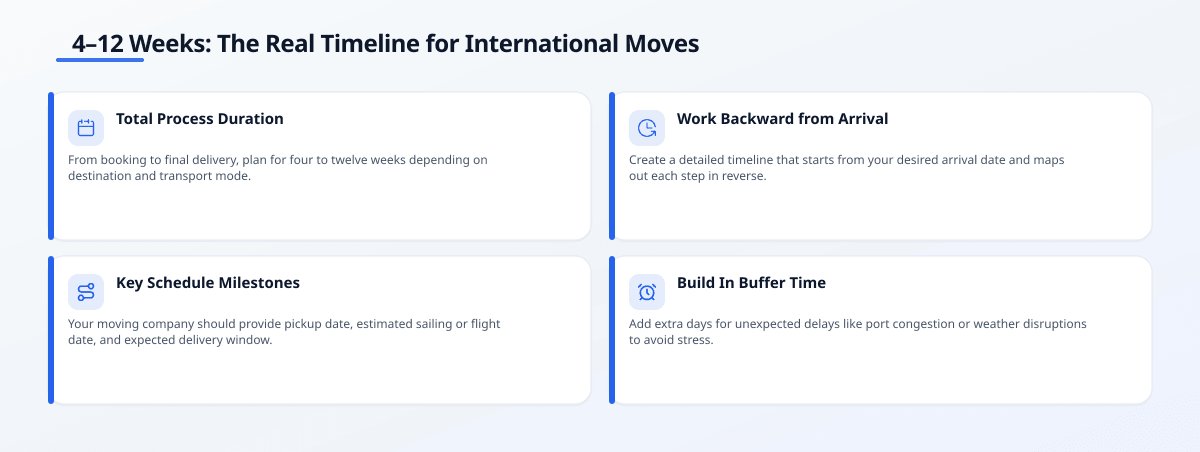
International moves rarely happen overnight. The entire process, from booking to final delivery, can take anywhere from four to twelve weeks, depending on the destination and mode of transport. To avoid unnecessary stress, create a detailed timeline and work backward from your desired arrival date. Your overseas moving company should provide you with a schedule that includes the pickup date, the estimated sailing or flight date, and the expected delivery window at your new home. Build in buffer time for unexpected delays, such as port congestion or weather disruptions.
One of the most common causes of delays is incomplete or incorrect documentation. Even a small mistake, like a misspelled name on a customs form, can hold your shipment for days. Double-check every document before it is submitted, and keep copies for your records. Another source of delay is failing to arrange for the delivery address to be accessible. If your new home is in a high-rise building, confirm that the moving truck can access the loading dock and that the elevator is large enough for your furniture. Your mover can advise you on these details, but it is your responsibility to communicate them in advance.
In addition, consider the timing of your move relative to the shipping season. Ocean freight rates tend to rise during peak seasons, such as summer and early fall, when many families relocate. If you have flexibility, booking during the off-season can save you money and reduce the risk of capacity shortages. Your mover can also help you choose between FCL (Full Container Load) and LCL (Less than Container Load) shipping. FCL is faster and more secure but requires you to fill an entire container, while LCL is more economical for smaller shipments but involves sharing the container with other customers, which can add time and handling.
Protecting Your Belongings: Insurance and Claims
No matter how careful a mover is, accidents can happen during an international move. That is why insurance is a critical component of your relocation plan. Most movers offer two types of coverage: released value, which is minimal (usually 60 cents per pound per item), and declared value, which provides full replacement cost for your items. The latter is more expensive but gives you peace of mind. Many homeowners or renters insurance policies exclude international transit, so you should purchase coverage through your mover or a third-party provider.
Before you purchase insurance, read the policy carefully. Understand the exclusions, which often include items like jewelry, cash, or fragile electronics unless they are specifically listed. If you have high-value items, you may need to purchase additional coverage or use a specialized insurer. Your mover should provide you with a copy of the policy and explain how to file a claim if something is damaged or lost. Keep a detailed inventory of your belongings, including photos and receipts, to support your claim.
If you do need to file a claim, do so promptly and follow the mover's procedures. Many contracts require you to note any damage on the delivery receipt before you sign it. If damage is discovered later, you may have a limited window to report it, sometimes as little as 30 days. Keeping all packing lists, customs forms, and correspondence with your mover will strengthen your case. While no one expects to lose belongings, being prepared makes the process less painful if it happens.
Preparing Your Household for an International Move
Preparation is the key to a successful international move. Start by decluttering your home well in advance. You do not want to pay to ship items that you will likely throw away once you arrive. Donate or sell furniture, clothing, and appliances that are not essential. This not only reduces your moving costs but also simplifies the packing process. Next, create a room-by-room inventory of everything you plan to take. This list will be used for the mover's estimate and for customs declarations, so be thorough.
When it comes to packing, you have two options: do it yourself or hire the mover's professional packers. For international moves, professional packing is highly recommended. The materials used are designed for long-haul transit, and the packers know how to protect fragile items from the rigors of a sea voyage. If you decide to pack some items yourself, use sturdy boxes and plenty of cushioning. Mark each box with its contents and destination room, which will make unpacking easier. Do not pack prohibited items like batteries or aerosol cans, as they can be dangerous and may be confiscated.
Finally, consider what you will need during the transit period. Since your belongings may not arrive for weeks or months, pack a separate suitcase with essentials like toiletries, a change of clothes, and important documents. You should also carry any items that you cannot afford to lose or delay, such as passports, medical records, and valuable jewelry. Your overseas moving company can provide guidance on what to keep with you, but a good rule of thumb is: if you cannot replace it easily, take it with you.
Choosing Between Full Service and DIY International Moves
Some people consider managing their international move themselves to save money, but this is rarely a good idea. The complexity of customs regulations, freight logistics, and insurance makes it difficult for an individual to handle alone. A DIY approach might involve booking a shipping container, hiring a trucking company, and preparing customs paperwork yourself. While this can be cheaper, it also places all the responsibility on your shoulders. One mistake can cost you more than the money you saved, in both time and frustration.
Full-service international movers offer a turnkey solution. They handle everything from packing to customs clearance to delivery, and they are accountable for the safe arrival of your goods. This is especially valuable for families with children or professionals with tight schedules. You can focus on your work or family while the mover manages the logistics. The cost is higher, but the peace of mind is often worth it. If you are on a tight budget, you can ask for a hybrid service where you pack non-fragile items yourself and let the professionals handle the rest.
When comparing full-service movers, look for companies that are members of professional associations like FIDI or the American Moving and Storage Association. These memberships indicate a commitment to quality and ethical practices. Read online reviews and ask for references from recent customers, especially those who moved to the same country you are targeting. A mover with experience in your destination will know the local customs brokers and delivery options, which can save you time and money.
In conclusion, an international move is a complex process, but with the right overseas moving company, it can be a manageable and even exciting experience. This overseas moving companies international relocation guide has outlined the key steps: understanding the services you need, getting accurate quotes, navigating customs, protecting your belongings, and preparing your household. By following these guidelines, you can avoid common pitfalls and ensure that your move overseas is as smooth as possible. Remember to choose a mover that prioritizes communication, transparency, and care for your items, and you will be well on your way to starting your new life abroad.