

How to Choose International Relocation Companies and Services
Learn how international relocation companies and services handle customs, costs, and logistics, ensuring your overseas move is smooth and stress-free.

By Jason Adams
Moving to another country is one of the most significant decisions a person can make. The excitement of a new job, a new culture, or a new lifestyle is often paired with the stress of shipping household goods across borders, dealing with customs regulations, and coordinating logistics from thousands of miles away. This is where international relocation companies and services become essential. They do more than just move boxes; they manage the complex web of paperwork, timelines, and transportation that turns a chaotic move into a structured plan. Without their expertise, a simple oversight in documentation can lead to costly delays or damaged property. Understanding what these services offer, how they differ from domestic movers, and how to evaluate them is the first step toward a successful move abroad.
For many people, the phrase "international relocation" brings to mind large shipping containers and customs forms. However, the reality is that these services cover a full spectrum of support, from initial consultation and packing to destination services like unpacking and home setup. The best providers act as a single point of contact, coordinating everything from the door of your current home to the door of your new one. They handle the heavy lifting, both physically and administratively, so you can focus on the emotional and practical aspects of starting over in a new country. This guide will walk you through the critical factors to consider, the types of services available, and the questions you must ask before signing a contract.
Understanding the Scope of International Moving Services
International relocation is fundamentally different from a domestic move. While a cross-country move might involve a truck and a few days of driving, an international move involves ocean freight, air freight, customs clearance, and potentially weeks of transit time. International relocation companies and services are built to handle this complexity. They have networks of partners in destination countries, knowledge of local import regulations, and experience with the documentation required for household goods. This global reach is crucial because a mover without a reliable partner at the destination can leave your belongings in a warehouse for months.
The services offered can be divided into two main categories: origin services and destination services. Origin services include everything that happens before your goods are shipped: in-home surveys, professional packing, customs documentation, and transport to the port or airport. Destination services include customs clearance, delivery to your new home, unpacking, and even assembly of furniture. Some companies offer complete door-to-door service, while others provide door-to-port or port-to-door options. The level of service you choose will affect the cost and the amount of work you need to do yourself. For most expatriates and families, door-to-door service is the most convenient, but it is also the most expensive. Understanding these options helps you match the service level to your budget and needs.
Key Services Offered by Relocation Companies
When you engage a professional international mover, you are not just paying for transportation. You are paying for a suite of services designed to protect your belongings and simplify the process. Here are the core services you should expect from a top-tier provider:
- Pre-move survey and consultation: A representative visits your home to assess the volume of goods, identify fragile or high-value items, and provide an accurate quote.
- Professional packing and crating: Using high-quality materials and techniques to protect your items for the long journey, including custom crating for art, antiques, and electronics.
- Customs documentation and clearance: Preparing and submitting all necessary paperwork to ensure your goods legally enter the destination country without delays.
- Transportation and logistics: Arranging ocean or air freight, booking cargo space, and tracking your shipment from origin to destination.
- Destination services: Unpacking, furniture assembly, and removal of packing debris at your new home, often referred to as inside delivery.
- Storage solutions: Short-term or long-term storage at origin, destination, or in transit, which is useful if your new home is not ready.
These services are not just add-ons; they are integral to a smooth relocation. For example, a professional packer knows that a porcelain dish needs to be wrapped in acid-free tissue paper before being placed in a double-layered box, while a custom crate for a sculpture requires foam-lined corners. This level of attention reduces the risk of damage, which is your biggest concern when your goods are traveling across the ocean. Moreover, a company that handles customs documentation can save you from the nightmare of having your shipment held at the border while you try to figure out the required certificates.
It is also worth noting that international relocation companies and services often provide a dedicated move coordinator. This person is your single point of contact, available to answer questions and provide updates throughout the move. This is particularly valuable when you are in a different time zone or when you cannot physically check on your shipment. A good coordinator will proactively communicate with you and the shipping partners, ensuring that every stage of the journey is on schedule.
How to Choose the Right International Relocation Company
Selecting the right partner for your international move is a decision that should not be taken lightly. The difference between a good move and a horror story often comes down to the company you hire. Start by researching companies that are members of industry associations like the International Association of Movers (IAM) or FIDI Global Alliance. These memberships indicate a commitment to professional standards and a network of vetted partners worldwide. You should also check online reviews and ratings on platforms like Google and the Better Business Bureau, but remember to read the negative reviews carefully to understand how the company handles complaints.
Another crucial step is to request a detailed, in-home survey. A reputable company will insist on this before providing a binding quote. During the survey, the estimator will assess the volume of your goods, discuss any special requirements, and identify potential challenges. This is also your opportunity to ask questions about their experience with your specific destination country. For example, moving to Australia has different quarantine regulations than moving to Germany. The company should be able to explain these requirements and how they will handle them. After the survey, you should receive a written, binding estimate that itemizes all costs, including shipping, customs, and destination handling. Be wary of estimates that are significantly lower than others; they often come with hidden charges later.
You should also verify the company's insurance coverage. International moves involve multiple carriers and handlers, so the risk of damage or loss is higher than in a domestic move. Ask about the different levels of insurance they offer, from basic liability (which is usually minimal) to full replacement value coverage. Understand the claims process and what documentation you will need to provide in case of a claim. A transparent company will explain this clearly, while a less reputable one may try to obscure it. Finally, consider the company's communication style. Do they respond to emails and calls promptly? Are they patient and clear in their explanations? The quality of communication before you sign the contract is often a good indicator of what you will experience during the move.
The Importance of Customs and Documentation
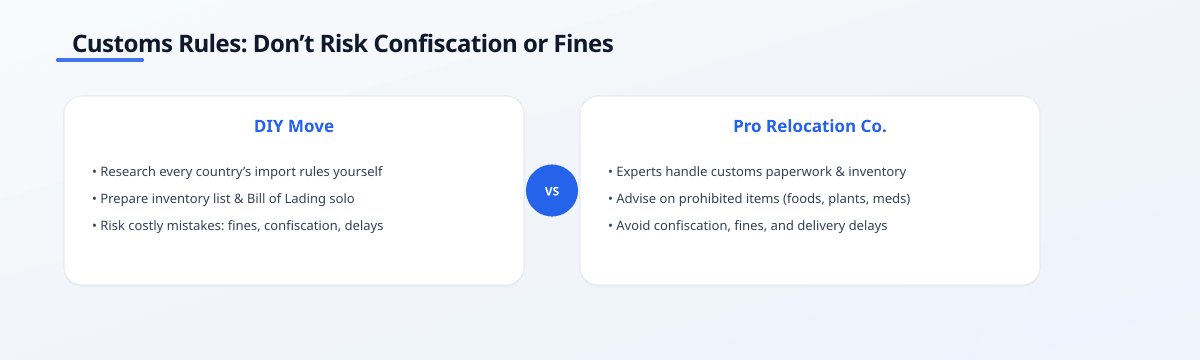
One of the most intimidating aspects of an international move is dealing with customs regulations. Every country has its own rules about what can be imported, what duties are owed, and what paperwork is required. International relocation companies and services are experts in this domain. They will prepare the inventory list, the Bill of Lading, and any other required documents. They will also advise you on prohibited items, such as certain foods, plants, or medications. A mistake in this area can lead to your goods being confiscated, a fine, or a significant delay in delivery.
A professional mover will also help you determine if you qualify for a duty-free import. Many countries allow residents who have lived abroad for a certain period to import their household goods without paying customs duties. This usually requires proof of residency abroad and ownership of the goods for a specified time. Your mover will guide you through this process, ensuring you have the right documentation, such as visas, passports, and residency permits. They will also handle the process of obtaining the necessary permits for items like firearms or vehicles, if applicable. This expertise is a primary reason why hiring a professional is not just a convenience; it is a necessity for a smooth move.
In addition to the destination country's regulations, you must also consider the departure country's export rules. Some countries have restrictions on exporting certain items, like cultural artifacts or antiques. A good mover will check both sides of the equation to avoid any legal issues. They will also ensure that your goods are properly packaged and labeled for the shipping method you choose. For instance, if you are shipping by sea, your goods will be in a container that may be exposed to humidity and temperature changes. Proper packing and the use of desiccants can prevent damage from moisture, a detail that experienced movers will not overlook.
Costs, Quotes, and Insurance for Overseas Moves
The cost of an international relocation is influenced by several factors: the volume of your goods, the distance to your destination, the shipping method (air vs. sea), the level of service, and the time of year. Because of this complexity, it is difficult to provide a simple price range. However, you should expect to pay more for air freight, which is faster and more expensive than sea freight. Sea freight is the most common and economical choice for full household moves. Within sea freight, you can choose between a shared container (less than container load, or LCL) and a dedicated container (full container load, or FCL). FCL is more expensive but offers more security and faster transit times. Your mover will recommend the best option based on the volume of your goods and your budget.
When you receive quotes from international relocation companies and services, make sure you understand what is included and what is not. A quote may list a base price for shipping, but then add surcharges for fuel, port handling, or remote delivery. Ask for a detailed breakdown of all costs, including any fees for customs clearance or destination services. A binding quote should protect you from unexpected price increases, but it is still wise to clarify the terms. Also, ask about the payment schedule. Most companies require a deposit upfront, with the balance due upon delivery. Be cautious if a company demands full payment before your goods are loaded.
Insurance is another area where you must be careful. Basic liability is often included, but it is typically calculated per kilogram and is far less than the actual value of your belongings. For example, if you have a $5,000 sofa that weighs 50 kilos, basic liability might only cover $100. To protect your investment, you should purchase full replacement value insurance. This type of policy covers the cost of repairing or replacing an item if it is damaged or lost. It is an additional cost, but it provides peace of mind. Before buying, read the policy carefully to understand what is excluded, such as damage due to improper packing (if you packed the item yourself) or acts of God. A reputable company will explain these exclusions clearly.
Preparing for Your International Move: A Step-by-Step Approach
Once you have selected your international relocation company, the process begins. The first step is to create a detailed inventory of everything you plan to move. This is not just a list of boxes; it should include the make, model, and serial number of electronics, the condition of furniture, and the estimated value of each item. This inventory will be used for customs and insurance purposes. Next, you will need to declutter. International shipping is expensive, so it makes sense to sell, donate, or dispose of items you no longer need. Not only will this reduce your shipping costs, but it will also simplify your life in your new home. Start this process early, as it can take more time than expected.
After the survey, you will schedule a packing date. Professional packers will arrive with boxes, tape, and wrapping materials. You should be present during the packing to point out any items that require special attention. This is also the time to set aside items you will carry with you, such as important documents, jewelry, and electronics you need immediately. Pack a personal "essentials" bag with a change of clothes, toiletries, and any medications. On the day of the move, the packers will label every box and create a packing list. This list is crucial for customs, as it describes the contents of each box. Once everything is packed, the boxes will be loaded into the container or truck for transport to the port.
During the transit phase, your move coordinator will keep you informed of the shipment's progress. This is a good time to prepare your new home for arrival. Confirm your address with the moving company, and arrange for utilities to be connected. If you are moving to a country with a different electrical voltage, you may need to buy converters or adapters. The final stage is delivery. The destination crew will unload the container, carry the boxes into the correct rooms, and unpack your belongings. They will assemble furniture and remove packing debris. Do a final walkthrough with the crew to note any damages before they leave. Then, you can begin the process of settling in and making your new house a home. For more detailed guidance on this entire process, you can refer to our choosing global relocation companies for international moves guide, which offers additional insights.
Choosing the right international relocation companies and services is the most important decision you will make during your move. It is the difference between a stressful ordeal and a smooth transition. By understanding the services offered, evaluating potential partners carefully, and preparing thoroughly, you can ensure that your household goods arrive safely and on time, allowing you to embrace your new adventure with confidence.