

Out-of-State Moving Companies and Relocation Guide
This guide helps you choose trustworthy moving companies out of state relocation, covering costs, insurance, and packing for a smooth long-distance move.

By Mark Johnson
Moving to a new state is a major life event, often filled with equal parts excitement and anxiety. The logistics alone can feel overwhelming, from sorting through a lifetime of belongings to coordinating a move across hundreds or thousands of miles. One of the most critical decisions you will make is choosing the right moving company to handle the journey. This out-of-state moving companies and relocation guide is designed to demystify the process, helping you understand what to look for, how to prepare, and how to ensure your belongings arrive safely at your new home.
Unlike local moves, relocating across state lines involves unique regulations, pricing structures, and potential risks. You are not just hiring someone to load a truck; you are entrusting a team with your valuable possessions for an extended period. Understanding the landscape of national moving services is the first step toward a successful relocation. This guide will walk you through everything from estimating costs to navigating insurance, so you can approach your move with confidence and clarity.
Understanding Out-of-State Moving Costs
The cost of an interstate move can vary dramatically based on several key factors. Unlike local moves that are often billed by the hour, out-of-state moving companies typically provide quotes based on the estimated weight of your shipment and the distance traveled. The distance is calculated using the actual miles between your origin and destination, not just a straight line, and this can significantly impact the final price.
Another major cost driver is the volume of your belongings. Movers will conduct a survey of your home, either virtually or in person, to estimate the cubic feet of space your items will occupy in the truck. This is why it is crucial to be honest and thorough when listing your inventory during the quoting process. If you underestimate, you could face a higher final bill on moving day. Additionally, services like packing, unpacking, furniture disassembly, and storage will add to the overall cost.
To get the most accurate estimate, consider the following:
- Get multiple in-home or virtual surveys: Do not rely on phone quotes alone. Reputable movers will want to see your belongings to provide a binding estimate.
- Understand the two types of estimates: A binding estimate guarantees the final price, while a non-binding estimate is only an approximation and can increase based on the actual weight.
- Ask about additional fees: Inquire about charges for stairs, long carries, shuttle services, or oversized items like pianos.
By understanding these factors, you can better evaluate quotes and avoid surprise charges. It is also wise to remember that the cheapest quote is not always the best value. A slightly higher price from a company with a strong reputation and comprehensive insurance may be worth the peace of mind. After narrowing down your options, you can begin to prepare for the specifics of a long-distance move, which we cover in our best interstate moving and storage services guide.
Choosing the Right National Moving Company
Selecting a moving company for an out-of-state move is a decision that should not be taken lightly. Your belongings will be in transit for days or even weeks, so you need a team that is licensed, insured, and experienced in long-distance logistics. The Federal Motor Carrier Safety Administration (FMCSA) regulates interstate movers, and a company's USDOT number is a key indicator of legitimacy. Always verify this number and check the company's safety record on the FMCSA's website.
Beyond regulatory compliance, look for a company with a proven track record. Read customer reviews on platforms like Google, Yelp, and the Better Business Bureau, but pay attention to how the company responds to both positive and negative feedback. A company that values customer satisfaction will address complaints promptly and professionally. You should also confirm that they offer the specific services you need, such as full-service packing or temporary storage, and that they have experience handling items like antiques or electronics.
Here are some essential questions to ask any potential mover:
- Can you provide a binding, not-to-exceed estimate?
- What is your claims process, and what does your valuation coverage include?
- Do you use subcontractors for any part of the move?
- How do you handle delays or unexpected issues in transit?
Taking the time to thoroughly vet moving companies out of state relocation can save you from significant headaches down the road. A professional mover will be transparent about their processes and happy to answer your questions. They should also provide you with a copy of your rights and responsibilities as an interstate mover, which is a federal requirement.
Packing Strategies for a Cross-Country Move
Packing for an out-of-state move is fundamentally different from packing for a local one. Your items will be loaded onto a truck, transported over a long distance, and may be stored for a period. This means they need to be packed more securely to withstand the vibrations and shifting of the road. The weight of each box is also a critical factor, as the total weight of your shipment directly affects your final cost.
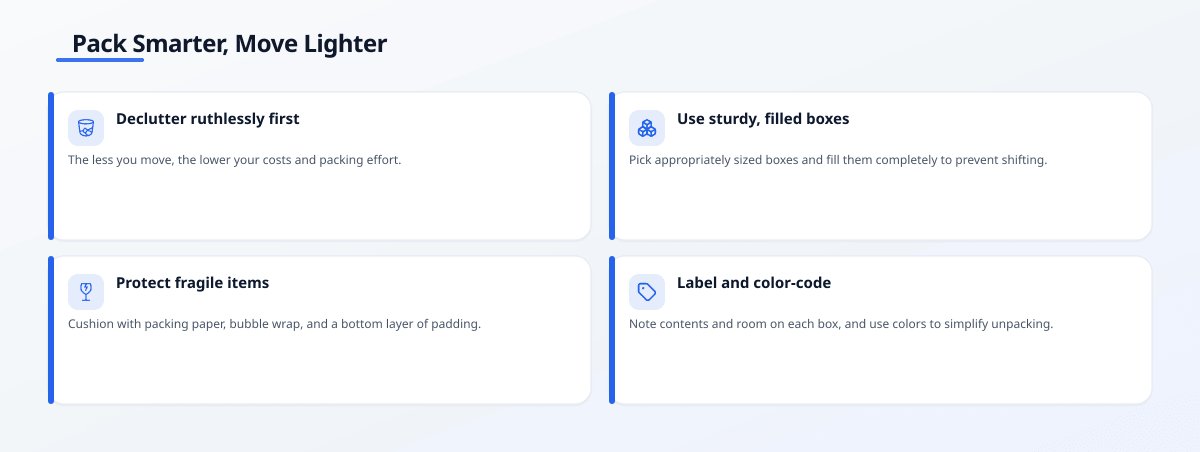
Start by decluttering ruthlessly. The less you have to move, the lower your costs and the less you have to pack. Once you have your final inventory, begin with items you use least often. Use sturdy, appropriately sized boxes and fill them completely to prevent items from shifting. For fragile items, use ample packing paper, bubble wrap, and a layer of cushioning at the bottom of the box. Label each box with its contents and the room it belongs to, and consider using a color-coding system to simplify the unpacking process.
If you are not confident in your packing skills, many national moving companies offer professional packing services. These experts use high-quality materials and techniques to ensure your belongings are protected. This can be especially valuable for items like fine china, artwork, or electronics. While it is an additional cost, it can save you time and stress, and it often provides better protection than DIY packing.
Essential Packing Supplies Checklist
Here is a list of supplies you will likely need for a successful DIY packing effort:
- Sturdy cardboard boxes in various sizes, including wardrobe boxes for clothing.
- Packing tape and a tape dispenser.
- Bubble wrap and packing paper for fragile items.
- Markers and labels for identifying boxes.
- Furniture pads or blankets to protect large items.
Remember that packing is a marathon, not a sprint. Start early and pack a little each day to avoid a last-minute rush. By the time your moving day arrives, you can be confident that your belongings are secure and ready for the journey ahead.
Navigating Moving Insurance and Liability
One of the most important aspects of any out-of-state move is understanding the insurance and liability options available to you. Federal law requires moving companies to offer at least two levels of liability protection: Full Value Protection and Released Value Protection. These are not optional add-ons; they are baseline requirements that determine how much the mover is responsible for if your items are lost or damaged.
Released Value Protection is the most basic option and is provided at no additional cost. However, it is extremely limited, as the mover's liability is capped at 60 cents per pound per article. This means a 10-pound item worth $500 would only be covered for $6. For most people, this is inadequate. Full Value Protection, on the other hand, requires the mover to repair, replace, or provide a cash settlement for lost or damaged items. This option is more expensive but offers significantly better peace of mind.
Beyond these two federal options, you may also have the ability to purchase additional insurance through a third-party provider. This can cover items that have high intrinsic value, such as jewelry, artwork, or collectibles. Before your move, create a detailed inventory of your belongings, noting their condition and estimated value. This documentation will be invaluable if you need to file a claim. If you do decide to file a claim, do so promptly and keep all receipts and documentation.
Preparing for Moving Day and Beyond
Once you have chosen your mover and packed your belongings, it is time to prepare for the actual moving day. The driver will conduct a final walkthrough of your home, verify the inventory, and note the condition of your items. This is your last chance to point out any issues, so be present and attentive. Also, confirm the estimated delivery date and the contact number for the driver or dispatcher, so you can stay informed throughout the journey.
While your belongings are in transit, you will be settling into your new home. This is a good time to set up utilities, change your address, and register your vehicle in your new state. When your belongings arrive, do a thorough inspection before the movers leave. Note any damage on the bill of lading, and do not sign off until you are satisfied. After the movers depart, unpack systematically, starting with the essentials.
Keep your moving documents organized for future reference. This includes the bill of lading, inventory list, and any receipts for additional services. In the unlikely event of a claim, you will need these documents to support your case. By staying organized and informed, you can ensure a smooth transition to your new home.
As you can see, a successful out-of-state move requires careful planning, diligent research, and a clear understanding of the moving process. By following the advice in this guide, you can approach your relocation with confidence, knowing that you have taken the necessary steps to protect your belongings and your investment. Whether you are moving for a new job, to be closer to family, or for a fresh start, the right preparation can make all the difference.