

Moving Furniture Across States Cost and Options
Compare moving furniture across states cost and options. Save money and hassle. Call us at (833) 762-3578 for a free quote.

By Brandon Hall
Moving your furniture across state lines is often the most stressful part of a long-distance relocation. You may wonder whether it is cheaper to sell everything and buy new pieces, or if hiring a professional mover is worth the expense. The truth is that the cost and the best option depend on the volume of furniture you own, the distance you are traveling, and the level of service you need. This guide breaks down the real numbers, compares the available methods, and gives you a practical framework to choose the right approach without overpaying.
Before you request quotes, you should understand the three main ways to move furniture: full-service movers, self-service moving containers, and DIY rental trucks. Each option has a different cost structure, level of convenience, and risk profile. A full-service mover handles packing, loading, transportation, and unloading. A moving container company drops off a portable unit at your driveway, you load it yourself, and the company ships it to your new state. A rental truck puts the entire job in your hands, from driving to loading to unloading. Your choice will directly affect your total cost and your peace of mind.
What Determines the Cost of Moving Furniture Across States
The price you pay to move furniture out of state is not a flat rate. Movers calculate quotes based on several key factors, and knowing them can help you avoid surprise charges. The first and most important factor is the weight of your shipment. Professional movers often charge by the pound for long-distance moves, with rates typically ranging from $0.50 to $1.50 per pound depending on the distance and time of year. For example, a 2,000-pound shipment could cost anywhere from $1,000 to $3,000 before additional fees.
The second factor is the distance between your current home and your destination. Moving 500 miles will cost significantly less than moving 2,000 miles, even if the weight is identical. Moving companies factor in fuel costs, driver time, and the number of days the crew spends on the road. Third, the number of stairs, elevator access, and the difficulty of the pickup and delivery locations can add to the price. If your new apartment is on the fifth floor without an elevator, expect a surcharge. Finally, the time of year matters. Moves between May and September are peak season, and rates are 20% to 30% higher than during the fall and winter months.
Below is a quick breakdown of the typical cost ranges you might encounter for a cross-country move of a standard three-bedroom home (roughly 5,000 to 7,000 pounds):
- Full-service movers: $3,000 to $7,000 for a 1,000-mile move, plus packing supplies and fees.
- Moving containers: $1,500 to $3,500 for a single container, plus the cost of loading labor if you hire helpers.
- DIY rental truck: $800 to $2,000 for the truck rental, plus fuel, tolls, and food/lodging for the drive.
These are broad estimates, and your actual quote may fall outside these ranges. The key is to get at least three written estimates from different providers and compare them side by side. A binding estimate guarantees the final price, while a non-binding estimate can increase by up to 10% on moving day. Always ask for a binding estimate to protect your budget.
Full-Service Moving: The Most Convenient Option
If you want the least amount of physical labor and the highest level of protection for your furniture, a full-service moving company is the way to go. Professionals will pack your items, disassemble beds and desks, pad the furniture, load the truck, drive it to your new state, and unload everything into the correct rooms. This option is ideal for families with large, heavy pieces like pianos, antiques, or sectionals that require special handling. It also reduces the risk of injury and damage, because experienced movers use proper lifting techniques and high-quality packing materials.
The convenience comes at a price, but the cost is often justified by the time and stress you save. You can expect to pay a premium of 30% to 50% compared to a DIY move, but you also gain accountability. A reputable mover will offer valuation coverage, which is a basic level of liability for damaged items. You can purchase additional full-value protection to ensure that any damaged piece is repaired or replaced at its current market value. When you compare quotes, ask about the valuation options, because the cheapest quote may offer only minimal protection.
For those who want a balance between full service and DIY, many moving companies offer a partial-service option. You can pack your own small items and have the movers handle only the large furniture. This can reduce costs by 15% to 25%, while still giving you professional help for the heaviest and most awkward pieces. When you request a quote, be specific about which tasks you will handle yourself, because that will change the estimate.
Moving Containers: The Middle Ground
Moving containers, such as PODS or U-Pack, offer a flexible and often more affordable alternative to full-service movers. The company delivers a steel container to your driveway, you load it at your own pace over a few days, and then the company picks it up and transports it to your new address. You can also choose to have the container stored at a facility if your new home is not ready yet. This option works well for people who want to save money but do not want to drive a large rental truck across the country.
The cost of a container is usually based on the size of the container and the distance it travels. A 16-foot container might cost between $1,500 and $3,500 for a 1,000-mile move, while a larger 20-foot container could be $2,000 to $4,500. You will also need to account for the cost of moving labor if you decide to hire help for loading and unloading. Many people hire two movers for a few hours, which can add $200 to $500 to the total. However, the flexibility of loading at your own pace is a major advantage, especially if you are moving out of a large house with many belongings.
One downside is that the container may sit at your new home for a few days before you unload it, and you might need a parking permit if you live in a city. Also, the container will not fit in a small driveway, so you need to verify that the drop-off location is accessible. Despite these limitations, containers are a popular choice for cross-country moves because they offer a clear price and eliminate the need to drive a heavy truck.
DIY Rental Trucks: The Budget-Friendly Route
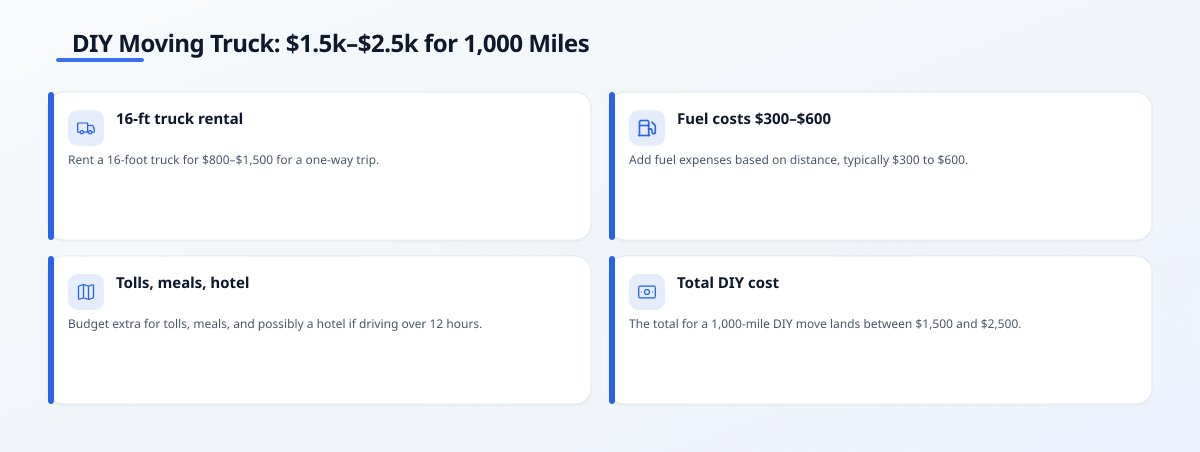
Renting a moving truck and driving it yourself is the most cost-effective way to move furniture across states, assuming you are physically able and comfortable driving a large vehicle. You can rent a 16-foot truck for around $800 to $1,500 for a one-way trip, plus fuel, which can be $300 to $600 depending on the distance. You will also need to budget for tolls, meals, and possibly a hotel if you are driving more than 12 hours. The total cost for a 1,000-mile DIY move typically lands between $1,500 and $2,500, which is significantly less than a full-service move.
The trade-off is the physical labor and the responsibility of driving a 20-foot truck through unfamiliar highways and parking lots. You will need to recruit friends or hire local movers to help with loading and unloading. If you hire a loading crew for two hours at each end, add another $300 to $600. You also bear the risk of damage to your furniture if you do not pack and pad it correctly. Rentals usually include basic insurance, but you may want to purchase additional coverage to protect your belongings and the truck itself.
If you decide to go the DIY route, choose a reputable rental company like U-Haul, Budget, or Penske, and book your truck early, especially during peak season. Make sure you understand the mileage charges and fuel policy. Some companies offer unlimited miles for one-way moves, while others charge per mile. A per-mile rate can quickly inflate your cost, so always ask for a total estimate that includes all fees before you book.
Comparing the Options: Which One Is Right for You?
To make the best decision, you need to evaluate your budget, timeline, physical ability, and the value of your furniture. If you have delicate antiques or a piano, a full-service mover is the safest choice. If you are moving a one-bedroom apartment and are comfortable driving, a rental truck will save you the most money. If you want a middle ground, a moving container offers flexibility and a predictable cost.
Here is a simple comparison to help you evaluate your options:
- Full-service movers: Best for heavy or fragile items, no physical labor, highest cost, includes packing and insurance options.
- Moving containers: Good for those who can load/unload, moderate cost, flexible timing, may require parking permits.
- DIY truck rental: Cheapest option, high physical effort, you drive, you manage packing and loading.
Remember that the cheapest option is not always the best value. If you injure yourself lifting a couch or damage a $2,000 dining table, the savings disappear. Weigh the cost of each method against the time and risk involved. For most families moving a three-bedroom house, the price difference between a container and a full-service mover is often less than $1,000, which makes the full-service option more attractive when you factor in the convenience.
Hidden Fees and How to Avoid Them
Moving quotes often come with hidden fees that can inflate your final bill by hundreds of dollars. Common charges include a fuel surcharge, a shuttle fee if the moving truck cannot access your street, a long-carry fee if the truck must park far from your door, and a stair carry fee. You should also ask about packing materials, like boxes, tape, and bubble wrap, which are often charged separately. To avoid surprises, request a written estimate that itemizes all potential charges, and ask the mover to explain any fee that seems vague.
Another hidden cost is the price of insurance. Basic valuation coverage is usually included, but it only pays $0.60 per pound per item. That means a 10-pound lamp would be reimbursed only $6 if it broke. Full-value protection costs extra but covers the actual replacement value of your items. It is a wise investment, especially if you own expensive furniture. When you compare quotes, ask for the cost of full-value protection and include it in your budget.
Finally, be wary of movers who ask for a large deposit upfront. Legitimate companies typically ask for a small deposit or nothing at all, with the balance due on delivery. If a company demands more than 20% of the total before moving day, consider it a red flag. You can protect yourself by reading reviews, checking the company's USDOT number, and verifying that they are licensed by the Federal Motor Carrier Safety Administration. For more detailed guidance on budgeting, you can refer to our cost of moving furniture budget tips and price factors article, which breaks down additional ways to save.
Smart Tips to Reduce Moving Furniture Across States Cost
Regardless of which moving method you choose, there are several ways to lower your total expense. First, purge your belongings before you move. Every item you do not take saves you money on weight, packing, and truck space. Sell or donate furniture that is old, damaged, or not worth the cost of moving. Second, book your move during the off-season (October to April) to secure lower rates. Third, pack your own non-fragile items, but leave the delicate pieces to the professionals if you are using a full-service mover.
Fourth, take advantage of the moving company's price-match guarantee if they offer one. Many movers will match a competitor's written quote, so do not hesitate to negotiate. Fifth, consider moving your furniture through freight shipping instead of a traditional moving company. You can crate your items and ship them on a pallet, which is often cheaper for small loads. Finally, if you are moving a long distance, compare the cost of shipping your car versus driving it, as that can free up space in the moving truck and reduce your total cost.
By applying these strategies, you can often save 10% to 20% on your moving budget without compromising on quality. The key is to plan ahead, get multiple quotes, and ask the right questions. Moving furniture across states is a significant investment, but with careful research, you can find a solution that fits your needs and your wallet.
Once you have a clear picture of your options and costs, you can confidently book your move. Whether you choose a full-service mover, a container, or a rental truck, the most important step is to prepare. Start by measuring your furniture, estimating the weight, and collecting quotes from at least three providers. Then, schedule your move for a time that avoids peak season if possible, and make sure you have all the necessary packing supplies on hand. With the right plan, your furniture will arrive safely at your new home without breaking the bank.