
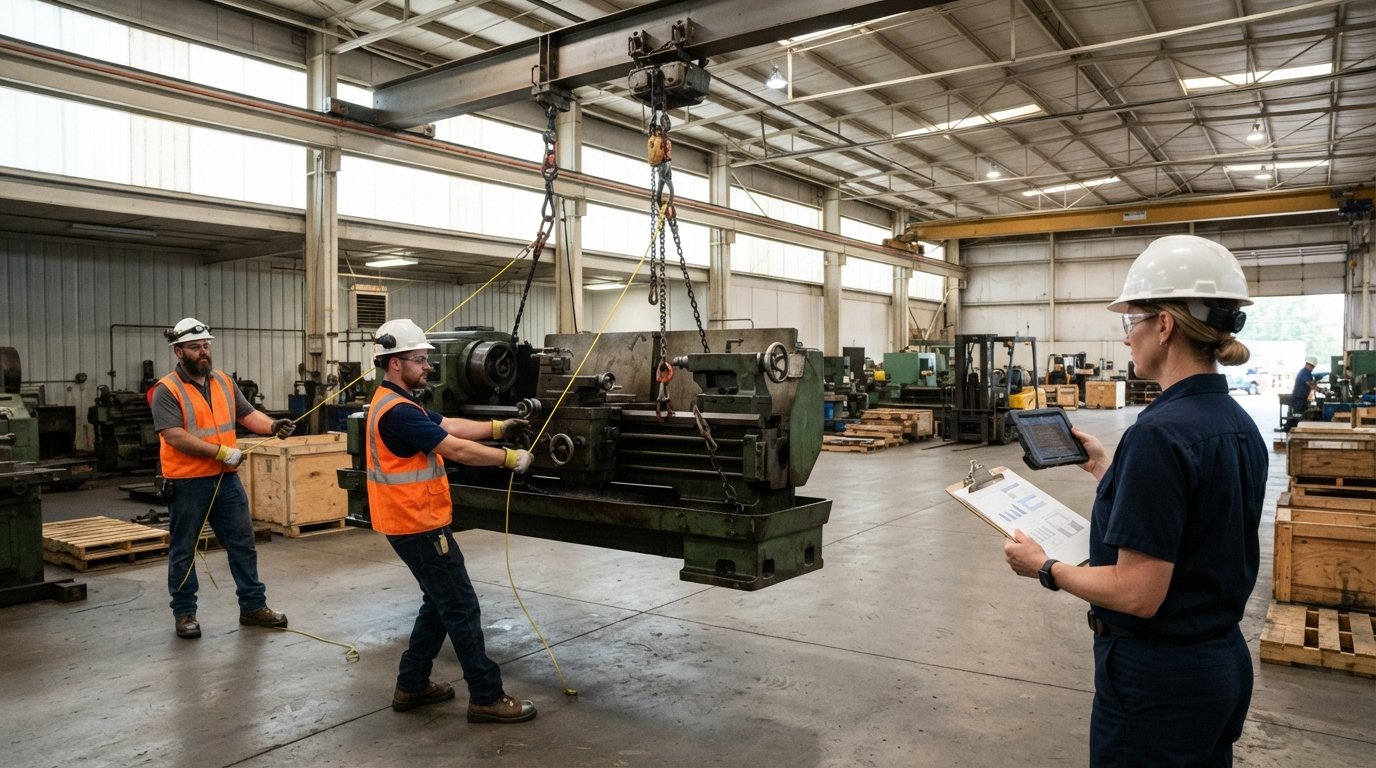
Industrial Relocation: Moving Heavy Equipment Safely
Industrial relocation planning moving heavy equipment and machinery starts with a rigging-grade inventory. Call (833)-484-8675 for expert moving support.

By Megan Hall
Every hour a production line sits idle during a plant move costs money, and every miscalculated lift risks both your machinery and your people. Industrial relocation planning for moving heavy equipment and machinery is not a scaled-up version of a household move: it is a disciplined engineering and logistics project where rigging assessments, utility shutdowns, permit windows, and insurance terms must align before the first bolt is loosened. Operations managers who treat the move as a sequence of small, verified steps consistently finish closer to budget and bring machines back online faster than those who improvise.
This guide walks through the practical side of that sequence, from the pre-move inventory through quote requests and final reinstallation. It focuses on what you can control: the quality of your preparation, the clarity of your documentation, and the questions you ask before signing anything. If your relocation also involves staff or household goods, our complete out-of-state relocation guide covers the personal side of the transition.
Start With a Rigging-Grade Equipment Inventory
A generic asset list is not enough for an industrial move. What the rigging crew needs is a document that records, for every machine, its weight, footprint, center of gravity notes, lifting points, utility connections, and any fragile subassemblies. Walk the floor with maintenance staff and photograph each unit from multiple angles, including nameplates and control panels. Record serial numbers and note which components must be removed before transport, such as spindles, tooling, or coolant tanks.
Disconnection planning belongs in this same phase. List every utility feed, compressed air line, coolant loop, and data connection tied to each machine, and confirm who is authorized to disconnect it. Electrical disconnects in particular usually require a licensed electrician, and for complex or sensitive systems you can find vetted local service professionals through resources such as Repairmen to handle appliance and electrical work around the facility. The inventory becomes the backbone of every later decision: rigging method, truck configuration, permit applications, and insurance declarations all draw from it.
A practical inventory entry for each machine should capture:
- Weight, dimensions, and center-of-gravity notes from the manufacturer or a scale ticket
- Certified lifting points and any restrictions on slinging or forklift access
- Utility connections, disconnection owner, and lockout tagout requirements
- Components to remove or secure before transit, with photos of the correct configuration
- Reinstallation sequence notes and any alignment or calibration needs after the move
Once this document exists, have the rigging contractor review it before the site walkthrough. Discrepancies caught on paper are far cheaper than discrepancies caught under a suspended load.
Schedule Utility Shutdowns, Permits, and Downtime Windows
Heavy machinery moves on a calendar as much as on a flatbed. Utility shutdowns usually require advance notice to your provider, and in some cases a formal scheduling window that cannot be changed at the last minute. Permits for oversize loads, crane placement, street closures, or extended working hours can take days or weeks depending on the jurisdiction. Build a master timeline that works backward from your target production restart date and marks every external dependency.
Production downtime is the constraint that shapes everything else. Decide early whether the move will be a full shutdown or a phased relocation where some lines keep running. Phased moves reduce revenue loss but complicate rigging access, so confirm with the contractor that equipment can be extracted safely while adjacent lines operate. Communicate the downtime window to customers and staff with some buffer, because weather, permit delays, and equipment surprises rarely cooperate with tight schedules.
A workable sequencing framework looks like this:
- Lock the production restart date and work backward to set the move window.
- File permit applications and book utility shutdowns before finalizing the rigging schedule.
- Sequence machines by dependency: equipment that blocks access to other units moves first.
- Schedule reinstallation and calibration immediately after delivery, not weeks later.
- Build a buffer day before restart for punch-list items and safety verification.
Review this timeline in a joint call with the rigging lead, your maintenance manager, and the utility coordinators. A single shared schedule prevents the classic failure where the crane arrives but the power is still on.
Confirm Insurance, Liability, and Rigging Coverage
Industrial moves concentrate risk: a dropped press or a cracked frame can exceed the value of the entire moving contract. Before work begins, obtain certificates of insurance from every party who will touch the equipment, including the rigging contractor, the transport carrier, and any subcontractors. Verify that coverage includes rigging and hoisting operations specifically, since general cargo policies sometimes exclude them.
Understand the difference between released value and full replacement value coverage, and declare the actual value of each machine. Ask who is responsible for damage during disconnection, during transit, and during reinstallation, because liability often shifts between parties at each stage. Confirm whether the policy covers consequential losses such as business interruption, and clarify the claims process and response time in writing. These conversations belong before the contract is signed, not after an incident.
Finally, document the pre-move condition of every machine with photos and video. A dated condition report protects both sides and speeds any claim. If a carrier resists providing coverage details, treat that as a signal to look elsewhere.
Request Quotes From Industrial Rigging Specialists
General movers are not riggers. When requesting quotes for industrial relocation planning moving heavy equipment and machinery, screen for contractors with documented experience in your equipment types and facility constraints. Provide each bidder the same package: the equipment inventory, site photos, floor plans, utility details, target dates, and insurance requirements. Comparable bids depend on comparable information.
Ask each contractor how they plan the lift, what equipment they will bring, and who supervises the crew on site. Request references from similar moves and, where possible, visit a job in progress. Clarify what the quote includes and excludes: crane rental, permits, crating, rigging hardware, reinstallation, and calibration are frequently itemized separately.
When comparing proposals, weigh these factors:
- Demonstrated experience with your specific machine types and weights
- Named site supervisor and crew certifications, including rigging qualifications
- Equipment list, including crane capacity and specialty lifting gear
- Insurance certificates with rigging coverage confirmed in writing
- Clear scope boundaries and a realistic schedule tied to your downtime window
Resist the temptation to award on price alone. The cheapest bid often omits permits, insurance, or reinstallation, and those gaps surface at the worst possible moment. A slightly higher quote with a complete scope and a credible safety plan is usually the better investment.
Manage the Move Day and Reinstallation
On move day, control access to the work area and enforce lockout tagout on every disconnected utility. Keep a single point of contact who can answer questions about equipment history and priorities. Verify that loads are secured and that transport routes match the permitted plan, and track each machine against the inventory as it leaves and arrives.
Reinstallation deserves the same rigor as extraction. Confirm that foundations, anchor points, and utility connections are ready before machines arrive, and schedule calibration and test runs immediately after positioning. A machine that sits unpowered for weeks invites corrosion, misalignment, and forgotten connection details.
Close the project with a walkthrough against the original inventory, a punch list of outstanding items, and a claims review if anything was damaged. Capture lessons learned while they are fresh, because the next relocation will benefit from them. With disciplined planning, a heavy equipment move becomes a controlled project rather than a crisis, and your production lines return to service on schedule.