
How to Move a Piano Upstairs or Through a Tight Doorway
Moving a piano upstairs or into a tight doorway demands careful planning and the right crew. Call (833)-484-8675 to connect with professional piano movers and avoid damage.

By Mark Johnson
That upright piano in the hallway or the baby grand in the living room can feel like a permanent fixture, but when it is time to relocate, the narrow stairwell and the tight doorway become the biggest obstacles. Moving a piano is not like carrying a sofa: the instrument weighs between 300 and 900 pounds, has an awkward center of gravity, and can be damaged beyond repair if it is dropped or even tilted incorrectly. Whether you are moving across town or just up one flight, you need a clear plan, the right equipment, and a realistic assessment of whether this is a job for you or for a professional crew. This guide walks you through the entire process, from measuring your piano against the space to deciding when to call in specialists.
Measure First: Can Your Piano Fit Up the Stairs and Through the Door?
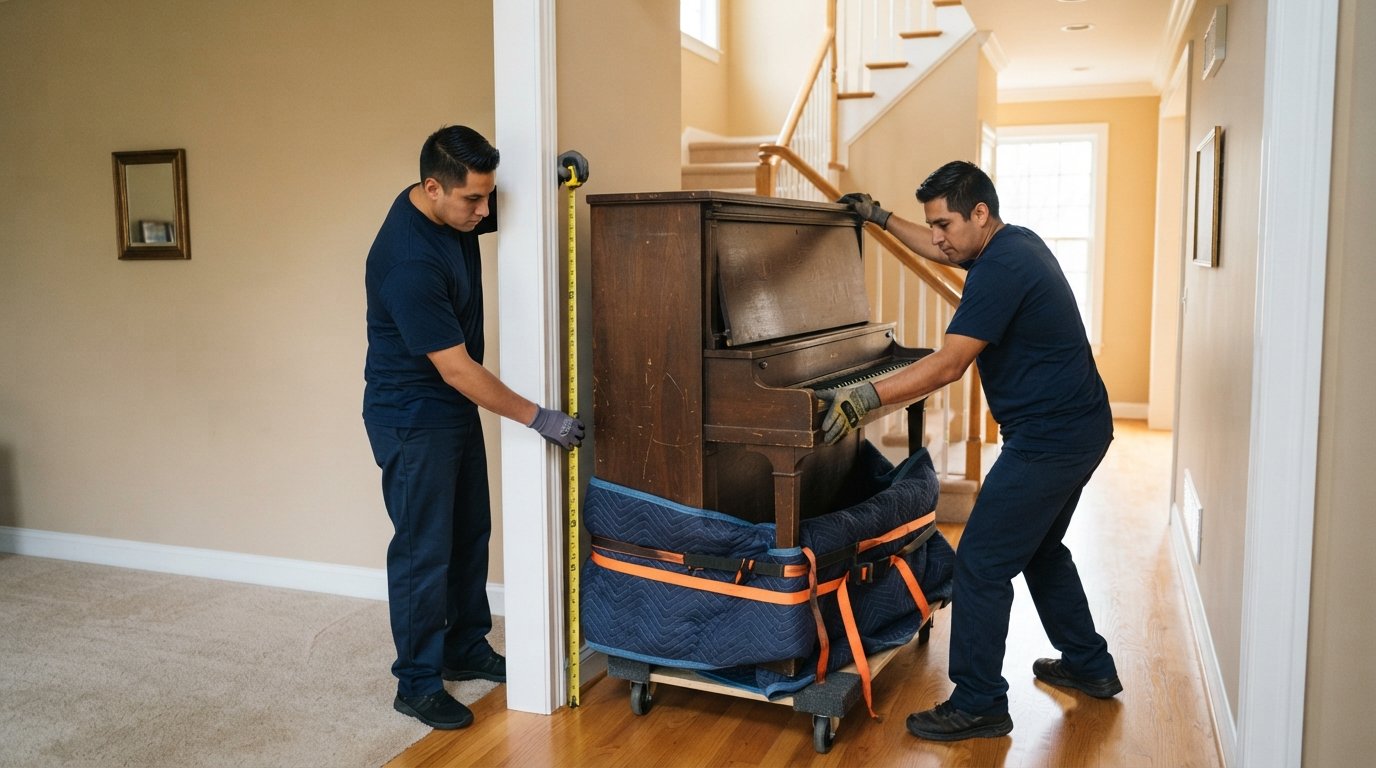
Before you recruit friends or book movers, you must determine whether the piano will physically fit through the path it needs to travel. A piano that is one inch too wide for a turn can stop a move cold. Start by measuring the piano itself: its width, depth, and height. Then measure every doorway, hallway, and stairway along the route. Pay special attention to the tightest spots: the front door, any interior doorways, the width of the stairwell, the landing at the top or bottom, and the ceiling height above the stairs. A staircase with a low ceiling or a tight spiral can make a piano impossible to maneuver without a crane or hoist.
Use a tape measure and a notepad, and sketch the path. For each turn, measure the diagonal clearance. A piano needs enough room to pivot; a 90-degree turn in a narrow hallway might require removing the door from its hinges or even taking out a window. If you are moving into an apartment building, measure the elevator: a piano might fit inside, but the door opening and the angle of entry matter just as much. If the elevator is too small, you will need to use the stairs, which brings its own challenges. Write down the smallest dimension in your path and compare it to the piano's smallest dimension (usually the depth when the piano is stood on end). If the piano's depth is greater than the narrowest doorway, you will need to angle it, which may not be possible in a tight stairwell.
Remember that the piano's legs, pedals, and lid can sometimes be removed to reduce its footprint. An upright piano can often be laid on its back (on a padded dolly) to slide through a doorway, but a grand piano is much more delicate and usually requires professional disassembly of the lid and legs. If you are unsure, consult a piano mover or technician; they can tell you quickly whether the move is feasible. As a rule of thumb, if the piano cannot pass through a 36-inch doorway without angling, you might need to remove the doorframe trim or find an alternative route.
When to Call Professionals: Specialty Equipment and Extra Crew
Moving a piano upstairs or into a tight doorway is not a one-person job, and it is rarely a two-person job either. A piano can weigh as much as a large refrigerator but with a much more fragile interior. The soundboard, strings, and action mechanism are sensitive to shock and tilting. Professional piano movers use specialized equipment: piano dollies with straps, piano boards (also called piano sleds or skids), and heavy-duty moving blankets. They also know how to lift safely, using their legs and keeping the piano balanced. If your path involves more than a few steps, a tight turn, or any significant distance, hiring a pro is almost always the safer and more cost-effective choice.
But you do not have to hire a dedicated piano mover if you are comfortable with basic furniture moving and have enough help. At minimum, you need three strong people for an upright piano and four for a grand. You also need the right tools. A piano dolly is essential; it is a low-profile platform with casters that fits under the piano and allows you to roll it rather than carry it. If you are moving up or down stairs, you will need stair climbers (also called stair rollers) or a specialized piano harness. These straps allow two people to carry the piano while keeping their hands free to grip the railing. For tight doorways, furniture sliders and a pry bar (to remove door trim) can make the difference between a smooth move and a damaged instrument.
Here are the signs that you should call a specialist rather than attempt a DIY move:
- The piano is a grand or baby grand (these are heavier and more delicate than uprights).
- The stairway has a tight turn, a low ceiling, or a narrow landing.
- The doorway is less than 32 inches wide or has a raised threshold.
- You have fewer than three strong helpers available.
- The piano has significant value (sentimental or monetary) and you cannot risk damage.
If any of these apply, it is time to get quotes from professional movers. In our guide on hiring furniture movers vs DIY moving, we explain how to weigh the costs and benefits, which is especially relevant for heavy items like pianos. A professional crew will have insurance and the experience to navigate tricky stairwells without injury or damage. The cost of a piano move is typically a few hundred dollars, which is far less than repairing a cracked soundboard or a broken leg.
Step-by-Step: Moving a Piano Upstairs Safely
Once you have decided to proceed, whether with hired help or a capable crew of friends, follow a careful sequence to minimize risk. The process varies depending on whether you are moving an upright or a grand, but the general principles are the same. First, clear the path completely. Remove rugs, furniture, and anything that could trip you. Protect the floors and railings with moving blankets or cardboard. If you are moving up stairs, measure the stairwell again and decide on the best angle of approach. For an upright piano, the safest method is often to lay it on its back on a piano dolly and roll it to the base of the stairs, then use a stair-climbing dolly or a team of strong people to lift and slide it up step by step. Never try to carry a piano up stairs without a dolly; the weight distribution makes it nearly impossible to hold safely.
Here is a step-by-step framework for moving an upright piano up a flight of stairs:
- Prepare the piano: Remove the legs, pedals, and any removable parts. Wrap the piano in moving blankets and secure them with stretch wrap. This protects the finish and prevents parts from snagging.
- Position the dolly: Tilt the piano carefully onto a piano dolly. Use straps to secure the piano to the dolly so it cannot slide off.
- Set up the stair climbers: If using a stair-climbing dolly, follow the manufacturer's instructions. Otherwise, have two people lift the front of the dolly while one person stabilizes the back. Use a strap or rope to control the descent (or ascent) from above.
- Communicate constantly: Assign one person as the leader who calls out commands (e.g., "lift," "step," "pause"). Everyone must move in sync. Take breaks as needed.
- Use leverage, not brute force: On stairs, slide the piano up one step at a time rather than trying to carry it continuously. This reduces strain and the risk of dropping.
For a grand piano, the process is more complex. You will need to remove the lid, the music rack, and often the legs. The piano is then turned on its side and placed on a piano board, which is a padded sled with straps. A team of at least four people is required to move it up stairs, with one person guiding from above and others lifting from below. This is not a job for amateurs; the risk of the piano tipping or the soundboard cracking is high. If you have a grand, seriously consider hiring a professional piano mover. The same applies to tight doorways: a grand piano may need to be stood on end to pass through a narrow door, a maneuver that requires expertise to avoid damaging the case or the internal mechanism.
Protecting Floors, Railings, and the Piano Itself
Damage during a piano move is not limited to the instrument. A dropped piano can crack floor tiles, gouge hardwood, or break a railing. Protect your home before the move begins. Lay down heavy moving blankets or cardboard along the entire path, especially on stairs and in doorways. Use painter's tape to secure them so they do not bunch up. Wrap railings and banisters with foam or blankets and secure with tape. Remove any hanging light fixtures or picture frames near the stairwell. If you are moving through a doorway, remove the door from its hinges and set it aside; this gives you a few extra inches and prevents the door from swinging into the piano.
The piano itself needs protection too. Moving blankets alone are not enough for the corners, which are the most vulnerable. Use corner protectors or thick foam pads and secure them with stretch wrap. For a grand piano, the lid should be removed and packed separately, and the legs should be wrapped individually. If the piano has a glossy finish, avoid using tape directly on the surface; use stretch wrap instead. Keep the piano away from extreme temperatures and humidity during the move; a sudden change can cause the wood to crack or the tuning to shift. After the move, let the piano acclimate to its new environment for at least 24 hours before playing it or having it tuned.
If you are moving a piano into a tight doorway, you may need to remove the door trim and even the threshold. This is often easier than trying to force the piano through a space that is too small. Use a pry bar and a hammer to carefully remove the trim, and label the pieces so you can reinstall them later. If the doorway is load-bearing or you are unsure, consult a contractor. In some cases, you can angle the piano through the door by tilting it, but this requires enough space on both sides. Never force a piano through a doorway; if it does not fit, stop and reassess. For more tips on protecting your home during a move, consider reading our article on hiring furniture movers, which covers insurance and damage claims.
Cost Factors for Stairs, Tight Access, and Long Carries
Professional piano movers charge based on several factors, and stairs and tight doorways are among the biggest cost drivers. A standard upright piano move on a ground floor might cost $150 to $300, but add a flight of stairs and the price can jump to $300 to $500 or more. A grand piano move starts around $400 and can exceed $1,000 if stairs or tight access are involved. These costs reflect the extra labor, specialized equipment, and time required. Many movers charge an additional fee per flight of stairs, typically $50 to $100 per flight. Tight doorways that require disassembly or extra maneuvering may also incur additional charges.
When getting quotes, be upfront about the number of stairs, the width of doorways, and any turns or narrow hallways. A mover who arrives unprepared may charge more on the day or refuse the job. Ask whether the quote includes insurance and whether there is a deductible. Some movers offer full-value protection, which costs extra but is worth it for a valuable instrument. If you are moving long-distance, the piano will likely be shipped on a dedicated truck or in a moving van with other items. Long-distance piano moves can cost $500 to $1,500 or more depending on distance and access. Always get a written estimate and confirm that the mover has experience with pianos. For general moving cost planning, our resource on budgeting for moves can help you allocate funds.
If you are looking for ways to save money on your move, consider scheduling during the off-season (fall or winter) or on weekdays. Some movers offer discounts for flexible dates. However, do not sacrifice safety for price; a cheap mover who damages your piano will cost you more in the long run. If your move involves other heavy items, such as a safe or a large piece of gym equipment, bundle them into the same job to save on labor costs. And if you are also considering energy-efficient upgrades for your new home, you might find useful resources on solar energy savings and installation costs to plan for future expenses.
Signs the Move Should Be Rescheduled or Handled by a Specialist
Sometimes the best decision is to stop and call in a specialist. If you encounter any of the following, do not proceed with a DIY move: the piano does not fit through the doorway even after removing the door and trim; the stairwell is too narrow or has a turn that makes it impossible to keep the piano balanced; the piano is too heavy for your crew to lift safely; or the weather is bad (rain, snow, or extreme heat can damage the piano and create slippery conditions). Also, if you or your helpers are not physically fit or have back problems, do not attempt the move. A piano can cause serious injury if dropped.
If you are moving a piano upstairs or into a tight doorway and you feel unsure at any point, hire a professional. The cost of a specialist is minor compared to the cost of a new piano or medical bills. Professional movers have the equipment, insurance, and experience to handle even the most challenging access. They can also advise you on whether the piano needs to be tuned after the move (it almost always does). Remember that Moving.Homes can connect you with professional movers who specialize in heavy items like pianos. You can request a free quote through our platform, and we will match you with vetted movers in your area.
Moving a piano is a demanding task, but with careful planning and the right help, it can be done safely. Measure twice, protect everything, and do not be afraid to call in the pros. Your piano will thank you with years of beautiful music in your new home.