

How to Choose Moving Transport Companies for Residential Moves
Learn how to choose reliable moving transport companies for residential moves and avoid scams, surprise fees, and damaged belongings.

By Eric Thompson
Moving your household is one of the most stressful life events, and the choice of transport company can make or break the experience. With hundreds of moving transport companies for residential moves advertising online, how do you separate reliable professionals from fly-by-night operators? The answer lies in knowing exactly what to look for, what questions to ask, and how to protect your belongings from the moment the truck leaves your driveway until it arrives at your new door. This guide walks you through every step, from understanding the types of moving transport companies for residential moves to reading the fine print in your contract, so you can move with confidence and peace of mind.
Understanding the Types of Moving Transport Companies for Residential Moves
Before you request a single quote, it is essential to understand that not all moving companies operate the same way. The industry broadly splits into three categories: full-service movers, self-service movers, and broker-based services. Full-service moving transport companies for residential moves handle everything, including packing, loading, transporting, unloading, and unpacking. They are ideal if you have the budget and want to minimize physical labor.
Self-service moving companies, on the other hand, provide a truck and a driver, but you do the packing and loading yourself. This is a middle-ground option that can save money if you are willing to put in the work. Finally, moving brokers act as intermediaries; they do not own trucks or employ movers, but they connect you with local and long-distance carriers. While brokers can be useful for comparison shopping, they add a layer of complexity, and you have less control over who actually moves your items.
For most residential moves, full-service movers offer the best balance of convenience and safety. They employ trained professionals who know how to wrap furniture, protect floors, and maneuver heavy items through narrow staircases. According to a 2025 survey by the American Moving and Storage Association, 68% of residential moves used a full-service moving company, with the average cost for a local move around $1,400 and a long-distance move around $4,900. Understanding these categories helps you narrow your search to the type of moving transport company that fits your needs.
Key Factors to Evaluate When Choosing a Moving Transport Company
Once you know the type of service you want, the next step is evaluating specific companies. Start by gathering recommendations from friends, family, and online reviews, but remember that a single review is not enough. Look for patterns across multiple platforms like Google, Yelp, and the Better Business Bureau. A company with a consistent history of positive feedback and a low complaint ratio is a good sign.
Next, verify the company’s licensing and insurance. For interstate moves, the Federal Motor Carrier Safety Administration (FMCSA) requires active USDOT numbers. You can check this number on the FMCSA’s website to see if the company has any safety violations or complaints filed against it. For local moves within a state, check your state’s moving authority. Insurance is equally critical; a reputable company should offer at least basic liability coverage, but for high-value items, you may want to purchase additional full-value protection.
Here are the key factors to evaluate in every moving transport company:
- Licensing and insurance: Verify USDOT numbers and insurance coverage before any conversation about pricing.
- Experience and training: Ask how long the company has been in business and how its movers are trained.
- Transparent pricing: Look for guaranteed flat rates, not hourly estimates that can balloon.
- Customer support: Test their responsiveness by calling or emailing with questions before you book.
- Reviews and reputation: Check multiple review sites and the Better Business Bureau for patterns of complaints.
After evaluating these factors, you can confidently request quotes from the top three companies. Each is a critical piece of the puzzle. For example, a company may have excellent reviews, but if its insurance coverage is minimal, you risk losing your antique china cabinet without compensation. Always dig deeper than the surface.
How to Get Accurate Quotes and Avoid Surprise Bills
Getting an accurate quote is the most important step in the entire process. The Federal Motor Carrier Safety Administration mandates that interstate movers provide a written estimate based on a physical or virtual survey of your belongings. Avoid companies that quote you over the phone without seeing your items; they are likely to add charges later. A reputable company will send a representative to your home, or in 2026, many offer video surveys using your smartphone camera.
There are two main types of estimates: binding and non-binding. A binding estimate is a guaranteed price; the final cost cannot exceed the quoted amount, even if your shipment weighs more than expected. A non-binding estimate is just an approximation, and the final bill can be up to 10% higher (or more) if the actual weight exceeds the estimate. For residential moves, always request a binding estimate to avoid surprise bills. Some companies also offer a "binding not-to-exceed" estimate, where you pay the lower of the estimated or actual cost, which is even better.
When you receive quotes, compare them line by line. Look for what is included: fuel surcharges, packing materials, stair carry fees, long-carry fees, and shuttle charges are common add-ons. A quote that seems $200 cheaper may not include these extras, so the final bill could be higher. Ask each company to itemize every possible fee, and get everything in writing. In our guide on choosing household moving companies, we emphasize that transparency is the hallmark of a trustworthy mover.
Red Flags and Warning Signs to Never Ignore
Unfortunately, the moving industry has its share of scams. Being aware of common red flags can save you from losing thousands of dollars and months of stress. Here are the most glaring warning signs that should make you reconsider a company.
First, if a company requires a large deposit upfront (more than 20% of the quoted price), walk away. Legitimate moving transport companies for residential moves typically collect payment upon delivery, not before. Second, if they show up in a rental truck with no logo, that is a major red flag; a professional company has its own branded equipment. Third, be wary of companies that refuse to do a visual survey or offer a quote without an in-person inspection. Fourth, if a company has a different name on its website than on its contract or truck, it may be operating under multiple identities to evade complaints.
Another common scam is the "lowball" quote. If one company’s estimate is dramatically lower than the others, they may be planning to hold your belongings hostage and demand more money before delivering. The FMCSA warns that any company that demands more than 10% above the estimate on delivery is violating federal regulations. Always read your contract and know your rights. If a company asks for payment in cash only, that is another red flag; reputable movers accept credit cards or bank transfers.
To protect yourself, follow this simple verification process before you sign anything:
- Check the company’s USDOT number on the FMCSA website.
- Request a physical or video survey of your items.
- Get a binding written estimate with a detailed inventory.
- Read online reviews on at least three platforms.
- Ask for proof of insurance and workers’ compensation.
If any step fails, move to the next candidate. It is better to spend an extra hour verifying than to lose your belongings for weeks.
The Role of Insurance and Liability Coverage
Insurance is not an optional extra; it is your safety net. The two primary types of coverage are released value protection and full value protection. Released value is the basic coverage that movers are required to provide at no extra cost, but it is minimal: it pays only 60 cents per pound per item. For a 50-pound television, that is a mere $30, which is far less than its replacement cost. Most residential moves should upgrade to full value protection, which requires the mover to repair, replace, or compensate you for damaged or lost items at their full replacement value.
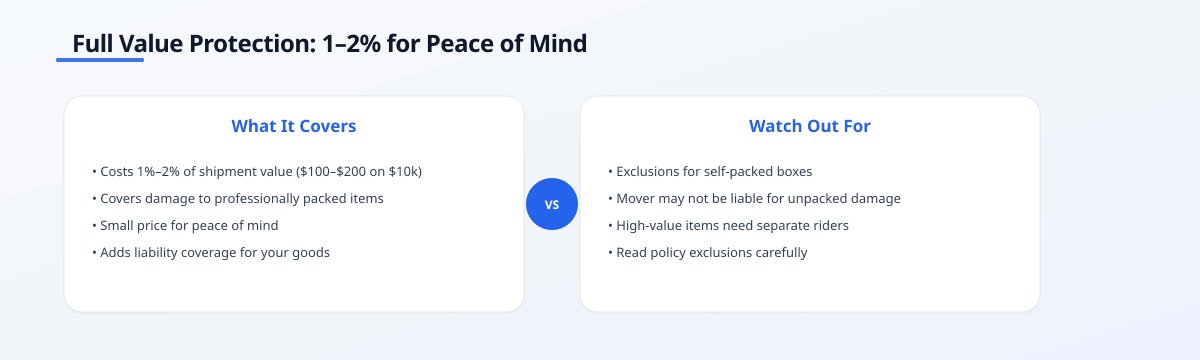
Full value protection typically costs an additional 1% to 2% of the estimated value of your shipment. For a $10,000 shipment, that is $100 to $200, a small price for peace of mind. However, be sure to read the exclusions. Some policies do not cover items that are not professionally packed, so if you pack your own boxes, the mover may not be liable for damage to those contents. High-value items like jewelry, art, and antiques may require separate insurance riders.
Before the move, take inventory of everything you own and assign a value to each item. This documentation will be crucial if you need to file a claim. You should also photograph any items that are already damaged or fragile. On moving day, do a final walkthrough with the foreman and note any pre-existing damage on the inventory sheet. After the move, inspect everything before the movers leave, and if you find damage, note it on the bill of lading. The claim process can be time-consuming, but professional moving transport companies for residential moves will work with you to resolve issues, especially if you have documentation.
Preparing for Moving Day: A Checklist for Success
Once you have selected your moving transport company, your job is not over. Proper preparation ensures a smooth move and reduces the risk of delays or damage. Start by decluttering your home; you do not want to pay to move items you no longer use. Donate, sell, or recycle anything you have not used in a year. This reduces your shipment’s weight, which can lower your moving cost.
Next, pack strategically. If you are using full-service movers, they will handle packing, but if you are packing yourself, use sturdy boxes, bubble wrap, and packing paper. Label every box with its contents and destination room. Disassemble large furniture and remove any loose screws or parts, placing them in a labeled bag taped to the furniture itself. Defrost your refrigerator and disconnect your washer and dryer at least 24 hours before the move.
On moving day, be present and available. Keep your phone charged, and have water and snacks for the crew. Walk through the house with the foreman before they start and again before they leave to confirm that everything is accounted for. Lock all windows and doors after they load the truck, and make sure you have the driver’s contact information and your bill of lading. If you have plants, check with your mover about whether they can transport them, as some states have restrictions. Finally, have a plan for your first night: pack a separate "essentials" box with toiletries, a change of clothes, medications, and important documents so you are not digging through boxes at midnight.
For a comprehensive step-by-step timeline, including a printable checklist, Moving.Homes offers a detailed moving checklist that covers everything from eight weeks out to moving day itself. Following a structured plan not only reduces stress but also ensures you do not forget critical tasks like forwarding your mail or transferring utilities.
Remember that communication is key. If you have questions about your move, do not hesitate to contact your moving transport company’s customer support line. Reputable companies, including those in the Moving.Homes network, offer 24/7 support so you can reach someone even if the move runs late. For example, if you need to change your delivery address or schedule, having a direct line to someone who can help makes all the difference.
Comparing Quotes: What to Look For Beyond Price
While price is a significant factor, it should not be the only one. A cheap move can become very expensive if the company is uninsured, unlicensed, or unprofessional. When comparing quotes from different moving transport companies for residential moves, create a comparison chart that includes the following: base price, estimated weight, binding vs. non-binding, insurance coverage, additional fees, and the company’s reputation. Look for a company that offers guaranteed pricing, which means the final price matches the quote, with no surprises.
Also, consider the level of customer service. Did the sales representative answer your questions patiently? Were they transparent about potential fees? A company that is upfront about costs and policies is more likely to be reliable on moving day. Read the contract carefully, especially the fine print about cancellation policies, rescheduling fees, and liability for delays. If a company has a poor response time or vague answers, that is a red flag.
It is also wise to check the company’s safety record. The FMCSA’s website provides a safety rating and any out-of-service violations. A company with multiple violations is risky, no matter how low its prices are. In 2026, many moving companies also publish their safety data on their websites, so look for that transparency. The best moving transport companies for residential moves will have a clean record and a history of satisfied customers.
Special Considerations for Long-Distance and Cross-Country Moves
Long-distance moves are more complex than local moves because they involve more logistics, longer timelines, and often multiple states. When choosing a moving transport company for a cross-country move, you need to consider how they handle deliveries. Some companies offer "direct" service, which means your items go straight from your old home to your new one. Others use "consolidation," where your items are loaded onto a truck with other shipments, which can be cheaper but may delay delivery.
Ask about the estimated delivery window. The FMCSA requires a written delivery window, but it can vary from a few days to a few weeks. If you need your items by a specific date, you may need to request expedited service, which costs more. Always ask about storage-in-transit options if your new home is not ready on time; this is a service where the mover stores your items temporarily at a facility, but it adds to the cost.
For long-distance moves, it is also crucial to understand the concept of "valuation." The FMCSA requires that your mover provides a written estimate of the value of your items, and the liability you choose (released or full value) will be based on that figure. Be accurate in your inventory; if you undervalue items, you cannot claim more later. Some long-distance movers also offer additional services like vehicle shipping or storage, which can simplify your logistics. Moving.Homes connects you with professionals who offer these services, so you can bundle your needs into one request.
Why Using a Platform Like Moving.Homes Can Simplify the Process
Given the complexity of choosing a moving transport company, many people find it easier to use a platform that vets and connects them with professionals. Moving.Homes is such a platform; it does not perform moves itself but facilitates free, no-obligation quotes from certified moving and storage experts. This approach saves you hours of research because you only receive quotes from companies that meet basic licensing and insurance requirements.
When you request a quote through Moving.Homes, you get access to a network of professionals who offer guaranteed pricing, trained movers, and 24/7 support. The platform is designed to reduce the stress of moving by simplifying the comparison process. Instead of contacting a dozen companies individually, you fill out one form and let the network come to you. This is especially valuable for long-distance or international moves, where finding a trustworthy company is even more challenging.
Additionally, Moving.Homes provides a wealth of educational resources, including checklists, cost guides, and articles on every aspect of moving. These resources help you prepare for every stage, from packing to post-move settling in. By combining expert advice with a vetted network of movers, Moving.Homes positions itself as the one-stop resource for your entire relocation journey. Whether you are moving across town or across the country, starting with a trusted platform can give you the confidence you need to move forward.
In summary, selecting the right moving transport company for your residential move requires diligence, but it is a manageable process if you follow a structured approach. Understand the types of services, evaluate companies on licensing and insurance, get binding quotes, watch for red flags, and prepare thoroughly for moving day. And remember, you do not have to do it alone; platforms like Moving.Homes exist to connect you with professionals who can handle the heavy lifting, both literally and figuratively. Your move should be the start of an exciting new chapter, not a source of endless worry. With the right partner, it can be exactly that. Learn more