
How Much Does Moving Cost: Packers and Movers Estimate Guide
Get a clear packers and movers estimate. This guide explains what affects moving costs, how to avoid hidden fees, and how to get an accurate quote.

By Nicole Walker
Moving to a new home is an exciting chapter, but the financial side often feels like a dark cloud. You want a fresh start, yet the fear of unexpected costs can turn that excitement into anxiety. The most common question we hear is simple: how much does moving cost? The answer is not a single number, but a range shaped by your unique situation. Getting a clear packers and movers estimate is the first and most critical step to taking control of your budget and avoiding nasty surprises on moving day.
This guide breaks down the factors that influence your final bill, explains the different types of estimates you might receive, and shows you how to use a moving cost estimate to plan effectively. By the end, you will know exactly what questions to ask and what to look for in a quote, so you can move forward with confidence and financial clarity.
Understanding the Basics of a Moving Cost Estimate
A moving cost estimate is more than just a price tag. It is a detailed projection of the services you will need and the associated charges. Professional movers use a variety of data points to calculate this number, and understanding these components helps you see why quotes vary from company to company. The two primary categories of moving costs are based on the move's distance: local and long-distance.
For local moves, which are typically under 100 miles, the estimate is usually based on an hourly rate. The total cost is determined by multiplying the number of movers by the hourly rate, plus the time it takes to complete the job. For long-distance moves, the price is based on the total weight of your shipment and the distance traveled. This is why an accurate inventory of your belongings is essential for a reliable quote. A vague estimate based on guesses can lead to a final bill that is significantly higher than expected.
Key Factors That Influence Your Moving Quote
Several variables go into a precise estimate. The size of your home, the number of rooms, and the volume of belongings are the starting points. However, a professional mover will also consider the following:
- Time of year and day: Peak moving season (May to September) and weekends are more expensive due to higher demand.
- Accessibility: Stairs, elevators, narrow hallways, and long walks from the truck to your door can add time and labor costs.
- Special items: Pianos, safes, artwork, and antiques require specialized handling, custom crating, and sometimes extra equipment, which increases the price.
- Additional services: Packing, unpacking, storage, and shuttle services are all add-ons that will be itemized in your estimate.
- Insurance and valuation: Basic coverage is often included, but full-value protection or additional insurance will cost extra.
- Is the estimate binding or non-binding?
- Are all services (packing, loading, unloading, disassembly) itemized?
- What is the estimated weight and/or time?
- What is the transit time for long-distance moves?
- What is the level of liability coverage, and what does it cost?
- Are there any additional fees for stairs, elevators, or long carries?
Each of these factors contributes to the final figure. A detailed, in-home or virtual survey is the best way to ensure the moving company captures all of these elements in your packers and movers estimate.
Types of Moving Estimates: Binding vs. Non-Binding
When you request a moving cost estimate, you will encounter two main types: binding and non-binding. Knowing the difference is crucial for protecting your wallet. A non-binding estimate is an approximation based on the information you provide. The final cost can change if your actual shipment weighs more or requires more time than originally estimated. This type can be risky, as you might end up paying more than you planned.
A binding estimate, on the other hand, is a guaranteed price. Once you and the moving company agree on the estimate, that is the amount you will pay, regardless of the actual weight or time. This offers the most financial security. Some companies also offer a binding-not-to-exceed estimate, where you pay the lower of the estimated or actual cost. For the most predictable budget, always request a binding estimate. This is a key point to clarify when you are comparing quotes.
To get the most accurate estimate, you should provide a detailed inventory. Many professional movers, like those at Moving.Homes, offer free in-home or virtual surveys to ensure your quote is as precise as possible. This process eliminates guesswork and helps you avoid surprises on moving day.
How to Get an Accurate Moving Estimate
The best way to get a reliable moving cost estimate is to have a professional assess your belongings. This can be done in person or through a video call. During this survey, the mover will walk through your home, note every item, and discuss any special requirements. This is the perfect time to ask questions about the estimate process, insurance options, and any potential extra charges.
When you meet with a mover, be prepared to share details about your new home as well. Are there stairs? Is there an elevator? How far is the truck from the entrance? These details affect the labor time. Also, be honest about the contents of drawers and closets. Underestimating your belongings only leads to a higher final bill. The goal is to get a quote that reflects reality, so you can budget accurately.
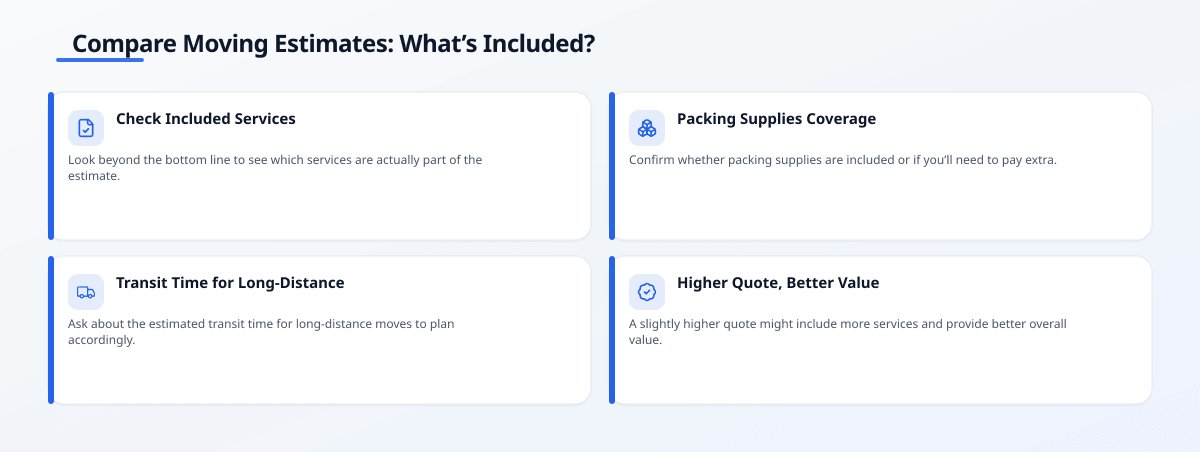
After you have a few estimates, compare them carefully. Look beyond the bottom line. What services are included? Are packing supplies included? What is the transit time for a long-distance move? A slightly higher quote might include more services and provide better value. To help you compare, here is a quick checklist of what to look for in an estimate:
Armed with this information, you can make an informed decision. You are not just looking for the cheapest price; you are looking for the most reliable and transparent service.
The Real Cost of Moving: Average Figures to Expect
While every move is unique, it helps to have a baseline. On average, a local move can cost anywhere from $300 to $2,000, depending on the size of your home and the number of movers. For example, a small apartment might cost around $300 to $500 for a few hours, while a four-bedroom house could exceed $1,500. Long-distance moves are more expensive, with average costs ranging from $2,000 to $10,000 or more, based on distance and weight.
These numbers are just starting points. A cross-country move of 3,000 miles for a typical three-bedroom house can easily cost $5,000 to $8,000. As you can see, the range is wide. This is why getting a personalized estimate is so important. Online calculators can give you a rough idea, but they cannot account for your specific items or the logistics of your move. A professional moving company will provide a more precise number based on a thorough assessment.
Remember, the lowest estimate is not always the best. Some companies offer low quotes to get your business, only to charge extra fees later. Look for a mover that offers guaranteed pricing and is transparent about all costs. As you research, you might find that a more comprehensive moving cost estimate guide can help you understand the nuances of pricing structures. For a deeper dive into the factors that affect pricing, you can review our detailed breakdown on how much a moving estimate costs.
How to Avoid Hidden Fees and Surprise Charges
The fear of hidden fees is a major concern for many people. The best way to protect yourself is to ask the right questions upfront. When you receive your moving cost estimate, ask for a complete breakdown of all potential charges. Some common fees to ask about include fuel surcharges, charges for oversized items, and fees for stairs or long carries. A reputable company will be upfront about these costs.
Another way to avoid surprises is to read the fine print. Understand the terms of the contract before you sign. What happens if your move is delayed? What is the policy for claims? Knowing these details ahead of time can save you stress and money later. A professional mover should be happy to answer all your questions and provide clear, written documentation.
Finally, book your move well in advance. Last-minute moves often come with higher rates due to limited availability. By planning ahead, you have more time to gather estimates and choose the best option for your needs and budget.
Making the Most of Your Moving Budget
Getting a fair moving cost estimate is the first step to a financially smooth move. Beyond that, there are ways to make your budget go further. One of the most effective strategies is to declutter before you move. The fewer items you have, the less it will cost to move them. Sell or donate things you no longer need, and you will save on both packing and transportation costs.
Consider doing some of the packing yourself. While professional packing services save time and ensure safety, doing it yourself can reduce your costs. If you do pack, make sure you use proper materials and label everything clearly. This will help the movers work efficiently and reduce the risk of damage.
Another tip is to be flexible with your moving date. If you can move mid-week or during the off-season, you may qualify for lower rates. Movers are often less busy during the fall and winter, so they may offer discounts to secure your business. Every dollar you save on the move itself is a dollar you can invest in your new home.
In summary, the cost of moving is not a mystery. By understanding the factors that influence the price, requesting a detailed packers and movers estimate, and asking the right questions, you can get an accurate moving cost estimate and avoid financial stress. Take the time to get multiple quotes, compare them carefully, and choose a mover that offers transparency and guaranteed pricing. Your move should be the start of a wonderful new chapter, not a source of financial worry. With the right information and a trusted partner, you can focus on what matters most: settling into your new home and making it your own.