Corporate Relocation Services for Business Moves
Moving an entire business is a massive undertaking. Unlike a residential move, a corporate relocation involves coordinating dozens of employees, sensitive IT infrastructure, irreplaceable data, specialized equipment, and the need to maintain operations with minimal downtime. A single misstep, such as a server arriving damaged or a key department left without phones for a week, can cost thousands in lost productivity and revenue. This is why companies turn to professional corporate relocation services for business moves. These specialized providers do more than just haul boxes. They bring project managers, logistics experts, and a systematic approach designed to keep your business running before, during, and after the transition. In this guide, we break down exactly how these services work, what they cost, and how to choose the right partner for your organization’s next move.
What Defines Corporate Relocation Services for Business Moves
Corporate relocation services differ sharply from standard moving labor. A general moving crew packs household goods and loads a truck. A corporate team, however, handles the complexities of commercial infrastructure. They manage the disconnection, packing, transport, and reinstallation of cubicle systems, server racks, telephone lines, and specialized machinery. The goal is to minimize business interruption, not simply to move objects from point A to point B.
These services often begin with a detailed site survey weeks before moving day. A project manager walks through both the old and new locations, measuring doorways, elevator dimensions, and loading dock access. They identify high-value assets such as laboratory equipment, prototypes, or sensitive documents that require extra handling. From that survey, they create a phased move plan that sequences departments by operational priority. For example, the IT department might move over a weekend while the sales team continues working from the old office until the new network is live.
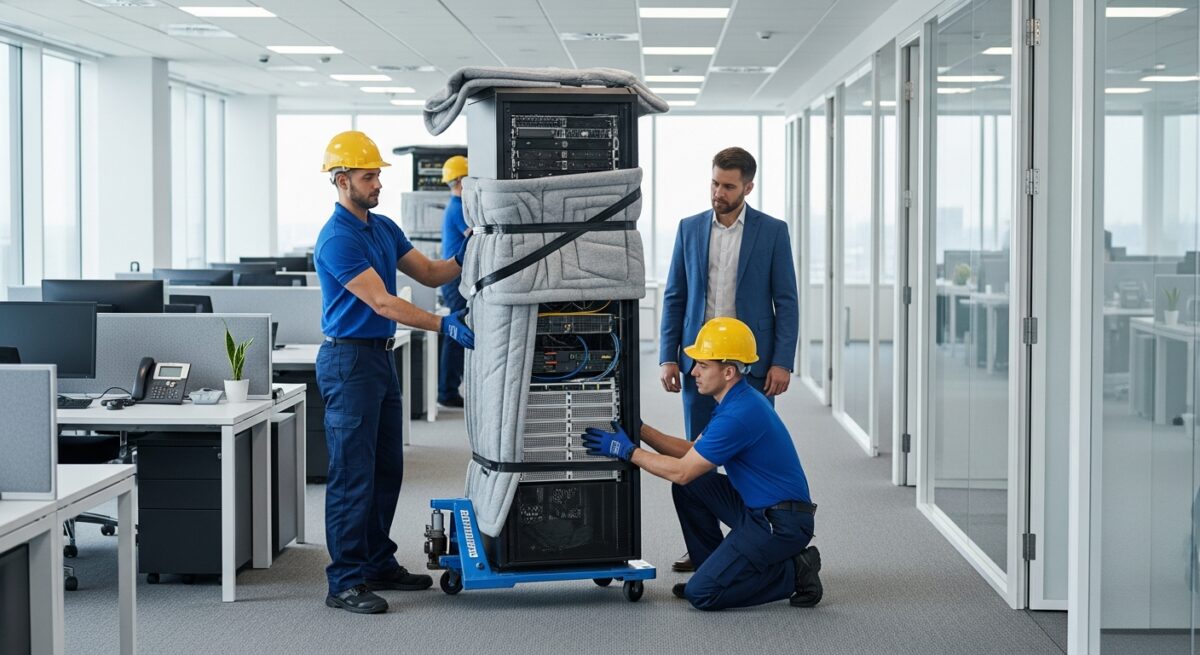
Professional business relocation services also include specialized packing materials designed for commercial items. Cardboard alone is not sufficient for a 40-pound server or a glass conference table. Providers use custom crating, shock-absorbing foam, and climate-controlled containers for sensitive electronics. They also offer debris removal and recycling of old furniture, which is critical for companies aiming to meet sustainability goals or lease-end cleaning requirements.
Key Services Included in a Comprehensive Move
When evaluating corporate relocation services for business moves, look for a provider that offers a full suite of capabilities rather than just trucking and labor. The best services function as a single point of contact for every moving-related task, which reduces the administrative burden on your internal team.
- IT and Technology Relocation: Includes careful disconnection, labeling, and transport of servers, network switches, workstations, and phones. Many providers also offer pre-move network testing and post-move reinstallation to ensure connectivity is restored quickly.
- Furniture and Cubicle Disassembly and Reassembly: Modular furniture systems require specific tools and knowledge to take apart and rebuild. Professional crews handle this efficiently, reducing the risk of damaged parts or lost hardware.
- Secure Document and Data Handling: For law firms, medical offices, and financial institutions, confidential records must be tracked and secured. Services include locked containers, chain-of-custody documentation, and shredding options for obsolete materials.
- Packing and Unpacking of Entire Offices: This covers everything from desk supplies and personal items to break room appliances and reception area decor. Teams use color-coded labels to ensure each box lands in the correct department.
- Storage Solutions: If the new space is not ready on time, short-term or long-term storage for furniture, inventory, or archived files is essential. Look for climate-controlled, secure facilities with 24-hour access.
These bundled services create a seamless experience. Instead of juggling separate vendors for IT, furniture installation, and document storage, you work with one project manager who coordinates all the moving parts. This single-source approach is the hallmark of a mature corporate relocation provider.
The Cost of Business Relocation Services
Pricing for corporate relocation services for business moves is not one-size-fits-all. Costs vary based on the size of the office, the distance of the move, the complexity of the equipment, and the level of service required. However, understanding the typical pricing models helps you budget accurately and avoid surprise bills.
Most providers charge either an hourly rate for local moves or a flat fee for long-distance relocations. Hourly rates for commercial moving crews typically range from $150 to $300 per hour for a team of two to three movers. For a full-day office move with multiple crews, costs can run from $2,000 to $10,000 or more. Long-distance moves are quoted based on weight and distance, often starting at $5,000 for a small office and climbing into the tens of thousands for large corporate campuses.
Additional fees may apply for specialty services. IT relocation often carries a separate charge because it requires certified technicians and specialized packing materials. Disassembly and reassembly of cubicles is typically billed per workstation, ranging from $100 to $300 per station. Storage fees are monthly and depend on the amount of space needed. The key to controlling costs is a detailed, itemized proposal from the moving company. Ask for a binding estimate that locks in the price based on the inventory list from your site survey. This protects you from last-minute rate increases.
How to Choose the Right Corporate Moving Partner
Selecting a provider for your business move requires more than reading online reviews. You need a partner with proven experience in commercial logistics, proper insurance coverage, and a track record of completing moves on schedule. Start by asking potential vendors for references from companies of a similar size and industry. A moving company that handles small retail shops may not have the expertise required for a multi-floor tech startup.
Verify that the provider carries commercial general liability insurance and worker’s compensation coverage. For high-value items like servers or prototypes, ask about additional valuation coverage. Most standard moving tariffs offer minimal protection based on weight, which is inadequate for expensive electronics. You may need to purchase full replacement value protection or a separate rider for specific assets.
Schedule on-site estimates with at least three providers. During the walkthrough, observe how the project manager evaluates the space. Do they ask about elevator schedules, parking permits, and building security protocols? Do they note fragile items and ask about company-specific priorities? A thorough estimator is a sign of a reliable mover. After receiving proposals, compare not just the price but the scope of services, the timeline, and the communication plan. For more detailed guidance on evaluating providers and creating a transition timeline, refer to our strategic guide to commercial relocation services for businesses, which covers request-for-proposal templates and key performance indicators for a successful move.

Planning the Timeline for a Smooth Transition
A corporate relocation typically takes three to six months from the decision to move to the final walkthrough. Rushing this timeline increases the risk of errors, equipment damage, and extended downtime. The planning phase should account for lease negotiations, space design, IT infrastructure setup, and the physical move itself.
Eight to twelve weeks before the move, conduct your site survey and finalize the floor plan for the new space. This is also the time to order new furniture if needed and to notify your IT team about network requirements. Six to eight weeks out, begin labeling and packing non-essential items such as archived files, seasonal decorations, and infrequently used equipment. Communicate the move schedule to employees and assign a point person from each department to coordinate with the moving team.
Two to four weeks before the move, confirm all logistics with the moving company. This includes parking permits, elevator reservations, and security access for the moving crew. Schedule the IT disconnection and reconnection dates. On moving day, have a designated leader from your company present to make decisions and solve problems. After the move, conduct a post-move inspection with the project manager to document any damage and ensure everything is in its proper place.
Navigating Employee Relocation Assistance
In many business moves, especially those involving a change of city or state, corporate relocation services extend to employee assistance. Companies often offer to cover part or all of the cost of moving their employees’ households. This is a critical retention tool and a key factor in ensuring key talent makes the transition with the company.
Employee relocation packages can include home sale assistance, temporary housing, moving of household goods, and spousal job search support. Some companies use a lump-sum payment approach, giving the employee a fixed amount to manage their own move. Others contract with a relocation management company that coordinates every detail. The right approach depends on your budget and the number of employees being relocated. For a company moving 20 or more employees, a dedicated relocation management firm often provides better cost control and a more consistent experience for staff.
If your business move involves financing multiple relocations, you may need to explore flexible funding options. Some moving companies offer payment terms that align with your cash flow. For larger capital expenditures related to the move, such as purchasing new equipment or funding employee relocation packages, business financing solutions can provide the liquidity needed to keep operations on track without straining your working capital.
Frequently Asked Questions
How far in advance should I book corporate relocation services?
For a small office move (under 10 employees), booking four to six weeks ahead is usually sufficient. For mid-sized to large corporate moves (50 or more employees), book at least eight to twelve weeks in advance. This allows the moving company time to conduct a thorough site survey, assemble the right crew, and secure any needed permits.
Can we continue working during the move?
Yes, with proper planning. Most corporate moves are phased so that different departments move at different times. IT and essential services are often relocated over a weekend or holiday to minimize disruption. A good project manager will create a schedule that keeps critical functions operational throughout the transition.
What insurance do I need for a business move?
At minimum, the moving company should carry commercial general liability insurance and worker’s compensation. For your cargo, standard valuation is based on weight (often $0.60 per pound per item), which is insufficient for expensive electronics or furniture. Purchase full replacement value protection or a separate policy for high-value assets.
How do I handle sensitive data during a move?
Work with a provider that offers secure document handling services. This includes locked containers, tamper-evident seals, and a chain-of-custody log. For digital data, ensure your IT team performs a secure backup and that all servers and hard drives are transported in locked, shock-protected cases.
Making Your Business Move a Success
Corporate relocation services for business moves are an investment in your company’s future. A well-executed move can improve office layout, upgrade technology, and boost employee morale by providing a fresh, modern workspace. The key is to start early, choose a qualified partner, and communicate clearly with your team. By treating the move as a project with defined phases, a realistic budget, and a dedicated project manager, you can minimize downtime and return to full productivity quickly. Your business deserves a transition that is as professional and efficient as the operations you run every day.