

Office Removal Services for Business Relocation
Plan a smooth corporate move with expert office removal services for business relocation. Call (833) 762-3578 for a free quote.

By Eric Thompson
Relocating a business is a major undertaking that touches every part of your operations. Unlike a residential move, an office move involves sensitive data, expensive equipment, bulky furniture, and the urgent need to minimize downtime. When the clock is ticking on your lease and your team is counting on you to keep things running, the value of professional office removal services for business relocation becomes immediately clear. A structured approach, supported by experienced movers, can transform a chaotic week into a manageable transition, protecting your assets and your bottom line.
The challenge is that many business owners underestimate the complexity involved. They see it as simply transporting boxes, but the reality involves coordinating with IT vendors, managing layout plans for the new space, and ensuring that insurance coverage is adequate for every piece of equipment. This is where a specialist in commercial logistics earns their keep. They do not just move items; they manage the entire flow of your physical workspace, ensuring that you are operational as quickly as possible.
Why Professional Office Movers Are a Strategic Asset
Attempting a DIY office move often leads to hidden costs that far exceed the price of a professional service. Lost productivity is the biggest factor. If your staff spends days packing and unpacking instead of doing their jobs, the lost wages alone can be staggering. Additionally, there is the risk of damaging specialized office furniture or IT infrastructure, which can cost thousands of dollars to repair or replace. Professional office furniture movers bring the right tools and techniques to handle these high-value items safely, which is a core component of office removal services for business relocation.
Furthermore, professional movers offer a level of liability coverage that internal staff simply cannot provide. If an employee injures themselves while moving a heavy desk, your business could face workers' compensation claims. In contrast, a professional moving company has liability insurance to cover both property damage and worker injuries. This transfer of risk is a critical benefit that protects your company's financial health and your employees' safety, making the investment in expertise a prudent business decision.
Planning the Corporate Move Timeline
Success in office relocation is directly tied to the quality of your planning. A successful move begins at least eight weeks in advance, though larger operations may need more time. The first step is to conduct a thorough audit of your current space. You need to identify what is essential to move, what can be sold or donated, and what should be recycled. This is the time to purge outdated files and unused furniture, as moving unnecessary items wastes money and space. Once you have a clear inventory, you can begin to map out the logistical requirements with your chosen moving partner.
After the audit, the focus shifts to communication and logistics. You must notify clients, suppliers, and employees of the upcoming change, and you need to coordinate with the building management at both the old and new locations. This includes booking elevator time, reserving loading docks, and securing any necessary parking permits. Your moving team will handle the physical relocation, but they rely on you to manage the building access and compliance requirements. A detailed timeline that includes these milestones is essential for keeping the project on track and avoiding last-minute surprises.
Creating a Detailed Moving Schedule
A day-by-day schedule is the backbone of a smooth office move. This schedule should break down the entire process into manageable phases, from the initial survey to the final sign-off at the new location. The schedule should assign specific tasks to team members, such as labeling inventory, managing the IT disconnection, and supervising the loading process. By having a clear schedule, you ensure that everyone knows their responsibilities and that no critical steps are overlooked.
The schedule also helps you coordinate with external vendors. If you are moving phone systems or requiring specialized installation for your new server room, you need to book those technicians to arrive after the movers have placed the equipment. Without a coordinated schedule, you risk having equipment sitting in boxes for days while you wait for technicians to become available. This is a common pitfall that professional office removal services for business relocation are designed to prevent, as they are used to working alongside other contractors.
How Office Furniture Movers Protect Your Assets
Office furniture is often heavy, awkwardly shaped, and difficult to disassemble. Workstations, cubicle panels, and executive desks require specific handling to avoid scratches, dents, and structural damage. Professional office furniture movers have the specialized equipment needed to handle these items, including furniture dollies, blanket wraps, and straps. They also have the experience to disassemble and reassemble modular furniture systems correctly, ensuring that your workstations fit together seamlessly in the new space.
Beyond physical protection, professional movers also provide planning expertise for the new layout. They can help you create a floor plan that optimizes space utilization and ensures that furniture is placed efficiently. This planning reduces the risk of items not fitting through doorways or into elevators, which is a common issue in older buildings. By relying on their expertise, you avoid the stress of trying to maneuver a massive conference table up a narrow staircase, and you ensure that your new office is ready for business immediately.
Managing IT Equipment and Data Security
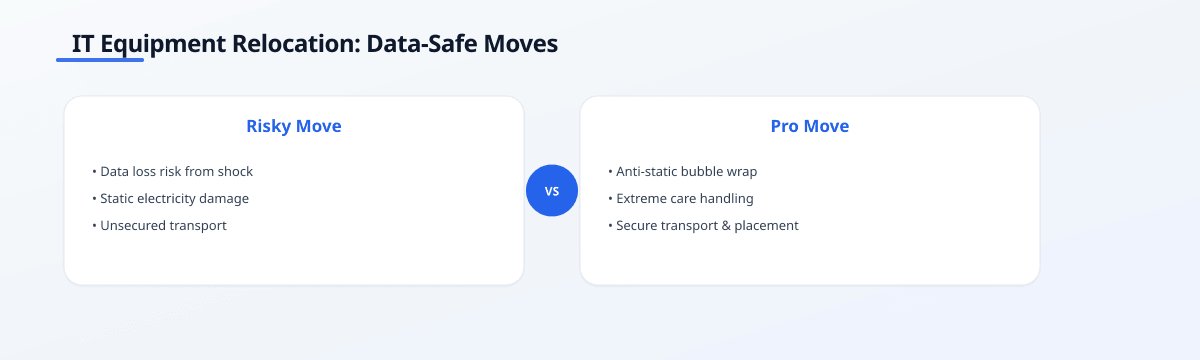
One of the most sensitive aspects of an office move is the relocation of IT equipment. Computers, servers, and networking gear contain critical business data, and their physical movement carries a risk of data loss. A professional moving company understands the importance of data security. They use specialized packing materials, such as anti-static bubble wrap, to protect electronic components from static electricity and physical shock. They also handle these items with extreme care, ensuring that they are securely transported and placed.
However, the physical move is only half the battle. You must plan for the secure backup of all data before the move begins. This is a non-negotiable step in any corporate relocation strategy. Once the equipment arrives at the new location, it must be set up in the correct order and tested before the rest of the team returns to work. This process is often managed by your internal IT department or a third-party IT consultant, but the movers must work in tandem with them to ensure a smooth handover. Proper planning here prevents costly downtime and potential data breaches.
Cost Factors in Commercial Relocation
The cost of office removal services for business relocation varies significantly based on several key factors. The volume of items being moved is the primary driver of cost, as this determines the size of the truck and the number of movers required. The distance between locations also plays a role, as does the complexity of the move. For instance, moving from a ground-floor office to another ground-floor office will be cheaper than moving from a 10th-floor office in a building with limited elevator access.
Other costs to consider include packing services, disassembly and reassembly of furniture, and the handling of specialized items. Many companies offer tiered packages that allow you to choose the level of service you need, from basic loading and unloading to full-service packing and unpacking. To get an accurate estimate, you should request a walkthrough or a virtual survey from multiple providers. This allows you to compare quotes accurately and ensure that there are no surprise fees added at the end of the job.
Hidden Fees to Watch Out For
While quotes are designed to be comprehensive, there are sometimes hidden fees that can inflate your final bill. It is critical to ask about charges for long carries, which is the distance from the truck to the building entrance. You should also inquire about fees for shuttle services if the new location does not allow large trucks to park directly outside. Stair carries, elevator fees, and charges for moving items that require special handling should also be clarified upfront.
To avoid these surprises, get everything in writing. A reputable company will provide a detailed breakdown of all potential charges in your contract. Ask them to walk you through the quote and explain the circumstances that might trigger an additional fee. This transparency is a hallmark of a trustworthy provider and is essential for protecting your budget. In our strategic guide to commercial relocation services, we outline more ways to keep your budget on track.
Creating a Stress-Free Move Day
When move day arrives, a clear plan and a professional team make all the difference. The moving crew will arrive early, and you should have a designated point of contact on site to answer questions and oversee the process. The crew will begin by protecting the floors and walls with specialized coverings, then systematically load the truck according to the inventory list. This organization ensures that items are placed in the correct rooms at the new location, reducing the time spent moving boxes around once they arrive.
On the receiving end, the team will unload the truck and place items according to the floor plan you have approved. This is where the labeling system you implemented during the packing phase pays off. Clear labels on each box and piece of furniture indicating the destination room and floor will speed up the process significantly. By the end of the day, you should be able to walk through your new office and see that everything is in its designated spot, ready for the IT team to reconnect the networks and for your employees to start settling in.
Post-Move Support and Settling In
The move does not end when the last box is off the truck. Reputable moving companies offer post-move support to address any issues that may arise. This can include returning to adjust furniture placement, picking up empty boxes for recycling, or even helping with minor assembly tasks. This level of support is crucial for ensuring that you are fully satisfied with the service and that no damage is left unaddressed.
Once the physical move is complete, the focus shifts to helping your team settle in. Ensure that essential amenities like the breakroom and restrooms are stocked and operational. Confirm that the Wi-Fi and phone systems are working, and provide a map of the new layout to help employees navigate. A smooth transition in the first few days sets a positive tone for the new office and reinforces the benefits of the relocation to your staff.
Ultimately, the goal of using professional office removal services for business relocation is to make the transition as seamless as possible. By handling the heavy lifting, logistics, and risk management, you free up your time and energy to focus on leading your team and maintaining business continuity. With the right partner, your new office can become a source of renewed energy and productivity for your entire organization.