
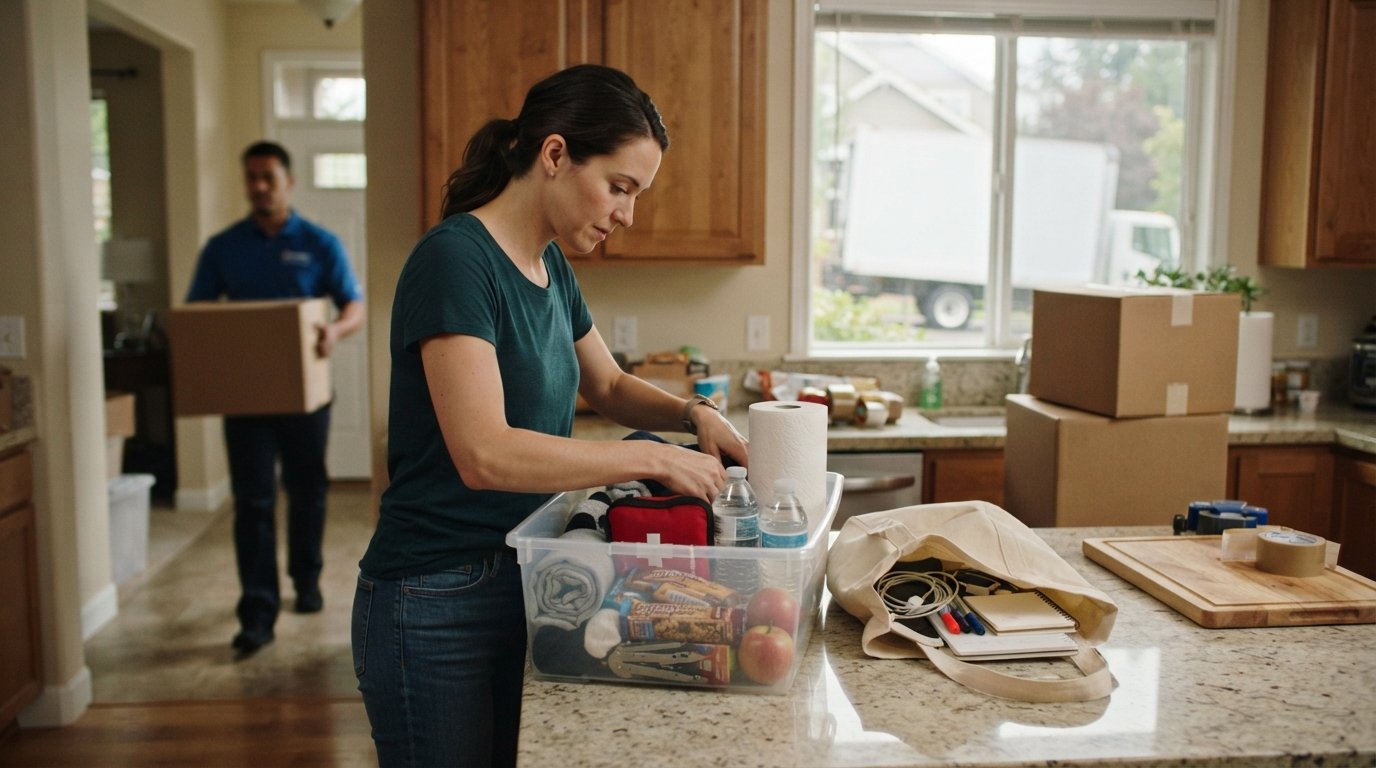
Moving Day Survival Kit Essentials to Keep on Hand
A moving day survival kit essentials list keeps your phone charged, documents safe, and family comfortable from the first box to the last.

By Brian Davis
The morning of your move arrives with a mix of excitement and chaos. The truck is idling outside, the crew is knocking at the door, and suddenly you realize your phone charger is buried somewhere in a sealed box labeled "miscellaneous." This is the moment a moving day survival kit proves its worth. Instead of digging through packed cartons while strangers wait, you reach for one clearly marked bag or bin that holds everything you need to stay functional, comfortable, and sane from the first box lift to the final walkthrough.
Building this kit takes maybe twenty minutes the night before your move, but it saves hours of frustration. Professional movers will tell you the same thing: the households that breeze through moving day are the ones that planned for the small essentials. Whether you are handling a studio apartment or a four-bedroom house, the same core items appear on every experienced mover's checklist. For renters navigating tight stairwells and building elevators, our apartment moving guide from packing to moving day pairs well with this survival kit strategy.
Why a Survival Kit Beats Improvisation
Moving day has a way of compressing time. Tasks that seemed manageable during the planning phase suddenly pile up, and decision fatigue sets in fast. When you cannot find your wallet, your keys, or a simple bottle of water, small problems snowball into real delays. A survival kit eliminates that scramble because everything lives in one known location that never gets packed onto the truck.
The psychology here matters as much as the logistics. Movers who observe a prepared client tend to move faster because they are not waiting for instructions or watching someone frantically search through boxes. Your stress level directly affects the pace and quality of the entire operation. Think of the kit as your command center: a portable base of operations that keeps you grounded no matter how chaotic the hallway or loading dock becomes.
There is also a financial angle. When you cannot find basic supplies, you end up buying duplicates at convenience store prices: a phone charger here, a roll of tape there, a snack because you skipped breakfast. Those small purchases add up. A well-stocked survival kit costs very little to assemble and prevents that death-by-a-thousand-cuts spending pattern on one of the most expensive days of your year.
The Core Essentials Every Survival Kit Needs
Start with documentation and valuables because these items are irreplaceable and should never ride in the moving truck. Your kit should include passports, birth certificates, social security cards, insurance paperwork, lease agreements, and any medical records you might need during the transition. Add prescription medications with enough supply to last several days beyond your expected move date, just in case of delays.
Next come the practical tools that keep you operational. Here is a compact list of items that experienced movers recommend keeping within arm's reach throughout the day:
- Phone charger and portable battery pack (your phone is your lifeline for directions, confirmations, and emergencies)
- Basic toolkit with a screwdriver, utility knife, and adjustable wrench for last-minute disassembly
- Painter's tape or masking tape for labeling boxes and securing loose items
- A permanent marker and notebook for inventory notes and contact information
- Scissors and a small roll of packing tape for resealing boxes that pop open
Beyond tools, think about personal comfort during what will likely be a long, physical day. Pack a change of clothes, comfortable shoes, and a small toiletry bag with toothbrush, deodorant, and any skincare items you use daily. If you have children or pets, include their immediate needs: diapers, formula, a favorite toy, pet food, a leash, and any medication. These items prevent meltdowns that can derail an otherwise smooth move.
Food and hydration deserve their own category. Moving burns calories, and hunger makes everyone irritable. Include shelf-stable snacks like granola bars, nuts, and crackers, plus a refillable water bottle for each family member. If you are moving in summer, add a small cooler with cold drinks and perishable snacks. Avoid heavy meals before the truck arrives, but do not skip eating entirely.
Documents, Valuables, and Items Movers Cannot Transport
Federal regulations prohibit moving companies from transporting certain items, and many of those items belong in your survival kit by default. Flammable materials like propane tanks, paint, and gasoline cannot ride in the truck. Neither can perishable food, plants (for long-distance moves), or pets. If you are unsure what your specific carrier will and will not take, ask before moving day so you can plan accordingly.
Valuables present a different problem. Jewelry, cash, collectibles, and important documents are technically allowed on the truck, but most moving experts strongly advise against it. Boxes get stacked, shifted, and occasionally lost. The safest approach is to keep all high-value items with you in a locked bag or personal vehicle. This includes laptops, external hard drives, and any electronics you rely on daily.
For homeowners who are also managing repairs or improvements at their new property, the weeks around a move often involve coordinating multiple contractors. If you need help finding reliable professionals for anything from a quick plumbing fix to a full bathroom remodel, FreeQuotes.Contractors connects homeowners with pre-vetted local contractors and provides free project quotes, which can be a useful resource when your to-do list extends beyond unpacking boxes.
Building Your Kit: A Step-by-Step Approach
Assembling a survival kit is straightforward if you approach it methodically. Do not wait until the night before your move. Start gathering items at least a week in advance so you are not hunting for a phone charger while the movers are loading your couch.
Follow this sequence to build a kit that actually works:
- Choose a durable container. A clear plastic bin with a lid works best because you can see the contents, and it will not collapse when stacked. A sturdy tote bag or small suitcase also works if you prefer something more portable.
- Create categories. Group items into logical sections: documents, tools, comfort items, food and water, and children or pet supplies. Use smaller bags or pouches within the main container to keep everything organized.
- Label everything clearly. Write "SURVIVAL KIT: DO NOT PACK" in large letters on the outside. Tell your movers explicitly that this container stays with you and should not go on the truck.
- Do a final check the morning of the move. Verify that you have your keys, wallet, phone, charger, medications, and any items you will need for the first twenty-four hours in your new home.
One often-overlooked step is preparing a separate "first night" bag for each family member. Even if your survival kit covers the basics, having individual bags with pajamas, a change of clothes, and toiletries means no one has to dig through boxes at midnight when everyone is exhausted. This is especially important if you are moving long-distance and will arrive at your new home well after dark.
If you are hiring professional movers through a service like Moving.Homes, confirm ahead of time what they will handle and what you need to manage yourself. Understanding the division of labor prevents last-minute surprises and helps you pack your survival kit with confidence.
Adapting the Kit for Different Move Types
A local apartment move requires a leaner kit than a cross-country relocation. For short moves within the same city, you can get away with a smaller container focused on immediate essentials: keys, wallet, phone, snacks, and basic tools. You are never far from a store, so over-packing the kit just means more to carry.
Long-distance and international moves demand a more comprehensive approach. When your belongings will be in transit for days or weeks, your survival kit becomes your lifeline. Include extra medications, copies of important documents, a portable charger, and enough clothing for several days. If you are moving internationally, add currency for your destination country, a universal power adapter, and printed copies of your visa or residency paperwork.
Families with young children should tailor the kit around predictable needs: diapers, wipes, formula, snacks, and entertainment like coloring books or tablets with headphones. Pet owners need leashes, food bowls, waste bags, and vaccination records. Seniors may want to include hearing aid batteries, glasses, and a list of emergency contacts. The principle is the same regardless of your situation: anticipate the needs that will arise in the first twenty-four hours and pack for them.
Common Mistakes to Avoid
The most frequent mistake people make is packing the survival kit onto the moving truck. Once it is on the truck, it is gone until unloading day. Keep it with you at all times, whether that means in your car, in your carry-on bag, or physically in your hand during the move.
Another error is over-packing. A survival kit is not a second suitcase. It should contain essentials, not everything you might conceivably want. If you find yourself adding items "just in case," ask whether you will truly need them within the first day. If the answer is no, leave them out.
Finally, do not forget to communicate. Tell your movers which items are off-limits for the truck. Tell your family where the kit is located. If you are coordinating with a moving company, confirm their policies on restricted items so you are not caught off guard. A few minutes of conversation prevents hours of confusion.
A well-prepared moving day survival kit essentials list is not about being overly cautious. It is about respecting the reality that moving is a complex, physically demanding process that rarely goes exactly as planned. When you have your essentials within reach, you can handle the unexpected without losing your cool. That calm confidence makes the entire experience better for you, your family, and the professionals helping you relocate.