
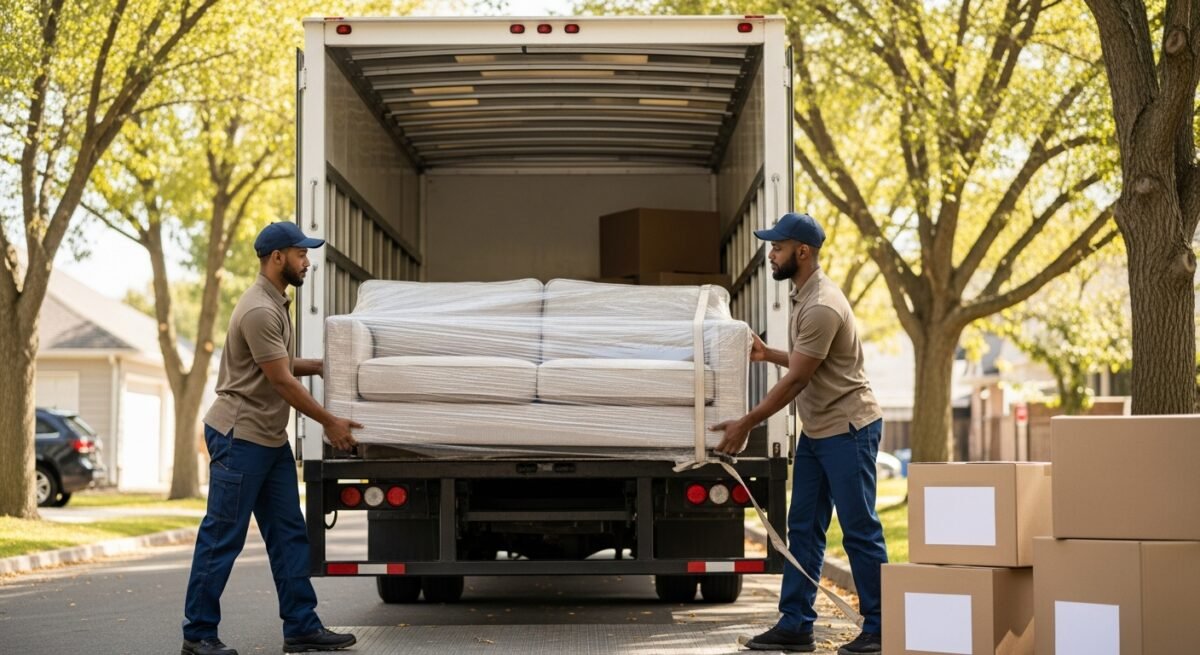
Your Essential Guide to Interstate Moving and Storage Services
This guide provides a clear framework for navigating interstate moving and storage services. Call (833) 762-3578 for personalized assistance with your relocation plan.

By Eric Thompson
Relocating across state lines is a monumental undertaking, a complex orchestration of logistics, planning, and decision-making that goes far beyond simply packing boxes into a truck. The process involves navigating federal regulations, comparing long-distance carriers, managing timelines, and often, integrating storage solutions into your relocation plan. This comprehensive interstate moving and storage services guide is designed to demystify the entire process, providing you with a clear, step-by-step framework to execute a successful, low-stress move. From initial research and budgeting to selecting the right full-service provider and understanding your storage options, we cover the critical elements that distinguish a chaotic move from a seamless transition to your new home.
Understanding Interstate Moving Regulations and Your Rights
Unlike local moves, interstate relocation is governed by federal law, specifically under the jurisdiction of the U.S. Department of Transportation’s Federal Motor Carrier Safety Administration (FMCSA). Any company transporting your household goods across state lines for compensation must have a valid USDOT number. This is your first and most crucial filter when vetting potential movers. A legitimate interstate mover must provide you with two critical documents: the Estimate and the Bill of Lading. The Estimate can be binding or non-binding, a distinction that significantly impacts your final cost. A binding estimate guarantees the total price based on the inventory list, while a non-binding estimate is an approximation, with the final cost calculated upon delivery based on the actual weight of your shipment and any additional services.
The Bill of Lading is the legal contract between you and the moving company. It outlines the terms of service, pickup and delivery dates, valuation coverage (replacement value vs. released value), and the agreed-upon charges. Never sign a blank Bill of Lading. Furthermore, movers are required to provide you with a copy of “Your Rights and Responsibilities When You Move,” a booklet published by the FMCSA. Understanding these documents is not just bureaucratic due diligence, it is your primary shield against scams and unexpected fees. For a deeper dive into vetting carriers, our resource on how to find reputable interstate moving companies outlines specific red flags and verification steps.
Choosing the Right Type of Interstate Moving Service
Interstate relocation services are not one-size-fits-all. The model you choose will depend on your budget, timeline, desired level of involvement, and the volume of belongings you own. The three primary models are full-service moving, containerized moving, and truck rental (DIY). Full-service moving is the most hands-off option. Professional movers handle everything from packing and loading to transportation, unloading, and even unpacking at your destination. This is ideal for large households, those with high-value items, or individuals seeking maximum convenience, though it is typically the most expensive option.
Containerized moving, offered by companies like PODS or 1-800-PACK-RAT, provides a hybrid solution. The company drops off a large storage container at your current home. You pack it at your own pace, they transport it, and you unpack it at your new residence. This offers flexibility and often includes a storage buffer, but requires your labor for loading and unloading. The truck rental route puts you fully in the driver’s seat. You rent the truck, handle all packing, loading, driving, and unloading. While this is the most budget-conscious option for smaller moves, it places all physical and logistical burdens on you and requires comfort with driving a large vehicle long distances. To plan a smooth home relocation, carefully weigh the pros and cons of each model against your personal circumstances.
Integrating Storage Solutions into Your Move
Storage is frequently a pivotal component of an interstate move. Timing mismatches between leaving your old home and accessing your new one, downsizing transitions, or simply needing time to unpack gradually all necessitate secure storage. Interstate moving companies often provide integrated storage services, which can be a major convenience. There are two main types: vaulted storage and warehouse storage. Vaulted storage involves placing your belongings in a dedicated, sealed container that is stored in a secure facility. Your items remain together and are not commingled with others. Warehouse storage involves movers unloading your items from the truck into a designated space within a large warehouse.
When evaluating storage options, ask key questions. Is the facility climate-controlled? This is essential for sensitive items like wood furniture, electronics, artwork, and important documents. What is the security protocol (gated access, surveillance, alarms)? What is the insurance coverage for goods in storage? How flexible are the access policies if you need to retrieve a single box? Understand the cost structure, which is usually a monthly fee based on the volume or weight of your stored goods. Having a clear storage plan prevents last-minute panic and ensures your possessions are protected during any gap in housing.
The Critical Steps of Planning and Preparation
A successful interstate move is built on meticulous planning that begins weeks, if not months, in advance. Start by creating a master moving checklist and timeline. Your first actionable step should be researching and obtaining estimates from at least three different licensed interstate movers. Insist on an in-home or virtual video survey for an accurate quote, as phone or email estimates are notoriously unreliable. During these surveys, be thorough. Point out every item to be moved, including those in attics, basements, and garages. This detailed inventory forms the basis of your estimate and prevents disputes later.
Next, embark on a ruthless decluttering campaign. The cost of your move is directly tied to weight and volume. Selling, donating, or discarding items you no longer need or want is the single most effective way to reduce moving costs. Host a garage sale, use online marketplaces, or schedule donation pickups. For the items you are keeping, begin packing non-essentials early. Use this opportunity to create a detailed box labeling system. Number each box and keep a master list detailing its contents and the room it belongs in. This is invaluable for organization and for verifying that all your possessions arrive at your new home.
Essential administrative tasks must not be overlooked. Create a moving binder or digital folder to keep all documents organized: estimates, contracts, inventory lists, and receipts. Arrange for the transfer or cancellation of utilities at your old address and setup at your new one. File a change of address with the USPS. Notify banks, insurance providers, subscription services, and relevant government agencies of your new address. Schedule time off work for moving days. For families, planning for pets and children during the moving days is crucial for safety and reducing stress.
Packing Strategies for Long-Distance Transit
Packing for an interstate move is fundamentally different from packing for a local shift. Your belongings will be in transit for days, possibly weeks, and will be handled multiple times. Durability and protection are paramount. Invest in high-quality, sturdy boxes in various sizes. Use plenty of packing paper, bubble wrap, and foam sheeting. For dishware and glassware, use cell kits for added stability. Heavier items like books should go in small boxes to prevent them from becoming too heavy and breaking. Lighter items like linens and pillows can fill larger boxes.
Furniture should be properly prepared. Remove legs from tables and desks if possible. Use furniture blankets and stretch wrap to protect surfaces from scratches and dings. Disassemble bed frames and other large items, keeping all hardware in labeled plastic bags taped to the furniture piece itself. When loading a truck or container, the goal is to create a solid, interlocked wall of boxes and furniture to prevent shifting during transport. The heaviest items go on the bottom and towards the front (near the cab) to balance the load. Always prepare an “Essentials Box” or suitcase that travels with you, containing medications, important documents, chargers, a change of clothes, basic toiletries, and snacks for the first 24 hours in your new home.
Navigating Moving Day and Delivery
On packing and loading day, be present and accessible. Review the Bill of Lading and the mover’s inventory sheet with the foreman. This sheet will list every item and its condition. Note any pre-existing damage on the sheet before you sign it. Keep this copy safe. As loading progresses, do a final walkthrough of your empty home to ensure nothing is left behind. Upon delivery, the process is similar. Be present to oversee unloading. Check the inventory sheet again as items come off the truck. Inspect items for any new damage that may have occurred in transit before you sign the delivery receipt. If damage is found, note it explicitly on the driver’s copy of the inventory sheet before you sign. This is critical for filing any subsequent claims.
The settlement of charges happens at delivery. If you have a binding estimate, you will pay the agreed amount. For a non-binding estimate, you will pay 110% of the estimated cost at delivery, with the final balance due after the final weight-based charges are calculated and billed. Always use a credit card for payment if possible, as it offers greater consumer protection than cash or check. The unloading process can be chaotic. Direct movers on where to place large furniture items. Your box numbering system will now prove its worth, allowing you to systematically move boxes to their correct rooms for unpacking.
Frequently Asked Questions
How far in advance should I book an interstate mover? For peak moving season (May through September), aim to book at least 8-12 weeks in advance. For off-peak months, 4-6 weeks is usually sufficient. Last-minute bookings limit your options and can be significantly more expensive.
What is the difference between valuation and insurance? Movers are required to offer two levels of valuation: Released Value Protection (included at no extra cost but only covers 60 cents per pound per item) and Full Value Protection (an added cost that covers repair, replacement, or cash settlement for lost or damaged items). Third-party moving insurance is a separate policy you can purchase for more comprehensive coverage.
Can movers refuse to deliver my goods if there’s a payment dispute? Yes. This is known as a “hostage load” scenario. Movers have a lien on your goods until all charges are paid. This underscores the importance of understanding your estimate and contract thoroughly before signing to avoid unexpected fees at delivery.
What items are movers prohibited from transporting? Federal regulations forbid movers from transporting hazardous materials such as aerosols, propane tanks, paint, chemicals, ammunition, and cleaning fluids. Plants, perishable food, and pets also cannot be shipped on the moving truck. Plan to transport these items yourself.
How are long-distance moving costs calculated? The primary cost drivers are the weight of your shipment, the distance it is traveling, and any additional services you select (packing, storage, shuttle service for large trucks). Accessorial charges for stairs, long carries, or bulky items also apply.
Executing an interstate move is a significant project, but with the right knowledge and preparation, it can be a manageable and even empowering experience. This interstate moving and storage services guide provides the framework. By understanding regulations, carefully selecting your service model, integrating storage needs, and adhering to a disciplined planning and packing process, you transform a daunting task into a structured journey. The key is to start early, ask detailed questions, document everything, and trust the process you have built. Your focus can then shift from the logistics of the move to the excitement of beginning a new chapter in a new home.