
Industrial Relocation: The Essential Guide to Heavy Machinery Movers
Ensure your capital equipment arrives safely and on schedule. For expert heavy machinery movers for industrial relocation, call (833) 762-3578.

By Brandon Hall
The successful relocation of a manufacturing plant, fabrication shop, or production facility hinges on a single, critical operation: the safe and precise movement of heavy machinery. This is not a task for standard moving services. It demands specialized expertise, engineered equipment, and meticulous planning. Heavy machinery movers for industrial relocation are the specialized contractors who transform the complex challenge of moving multi-ton assets into a seamless, controlled process. Their role is to ensure that valuable capital equipment, often worth millions and central to business continuity, arrives at its new location on time, undamaged, and ready for rapid recommissioning.
What Defines a Professional Heavy Machinery Mover
Not all moving companies are created equal. Professional heavy machinery movers, often termed riggers or industrial movers, operate in a distinct realm defined by extreme weights, precision, and risk management. Their core competency lies in handling equipment that cannot be simply loaded onto a standard trailer. This includes CNC machines, injection molding presses, industrial generators, turbines, printing presses, and assembly line components. The distinction from a standard commercial mover is profound. While a commercial mover focuses on office furniture and boxes, an industrial mover deals with load calculations, center-of-gravity analysis, and structural integrity of both the load and the transport path.
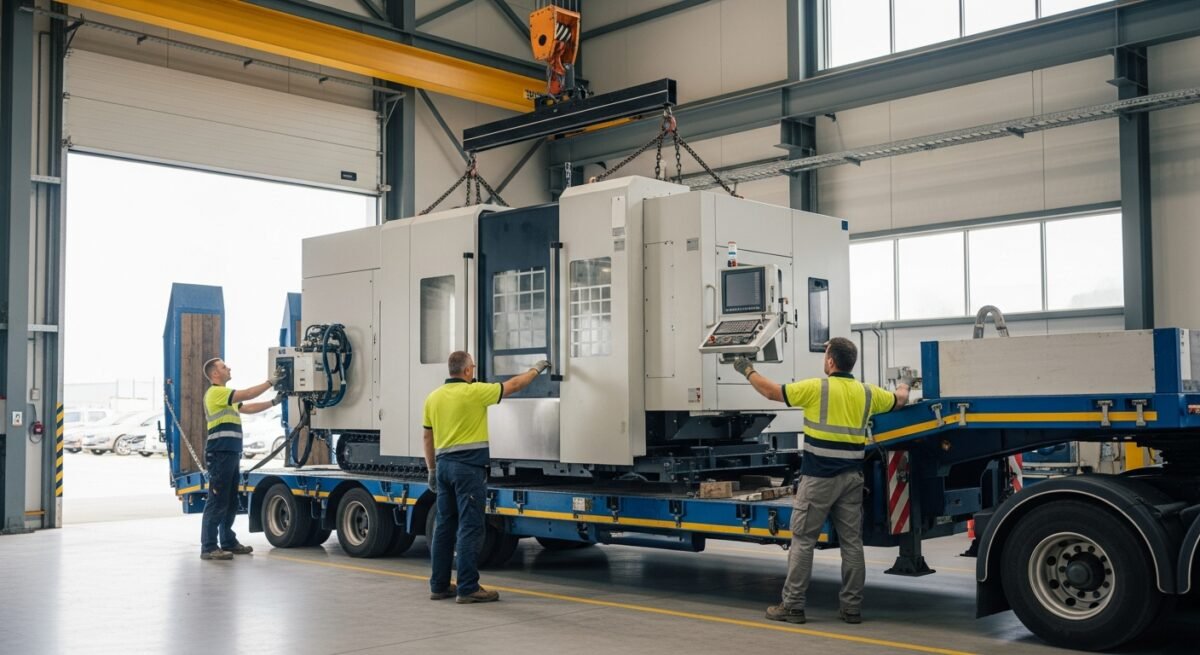
These specialists possess a fleet of specialized transport vehicles, such as lowboy trailers, extendable flatbeds, multi-axle trucks, and hydraulic modular trailers (SPMTs) for the largest loads. Their toolkit includes custom-engineered skidding systems, heavy-duty forklifts with capacities exceeding 50,000 lbs, gantry cranes, and an array of jacking and cribbing equipment. Beyond hardware, their most valuable asset is experienced personnel: certified riggers, crane operators, and project managers who understand the physics and logistics of moving immense, irregularly shaped objects through often confined spaces.
The Critical Phases of an Industrial Machinery Move
A successful industrial relocation is a multi-stage project, each phase building upon the last. Rushing or neglecting any single step can lead to catastrophic delays, damage, or safety incidents.
Phase 1: Pre-Move Planning and Engineering Assessment
This is the most important phase, where the move is won or lost. It begins with a comprehensive site survey at both the origin and destination facilities. Professional movers will assess every piece of equipment, documenting its weight, dimensions, center of gravity, and connection points. They will also survey the route, both internally and externally. Internally, this means measuring doorways, ceiling heights, floor load capacities, and column spacing. Externally, it involves planning the route on public roads, identifying potential obstacles like low bridges, tight turns, or weight-restricted roads. This phase results in a detailed move plan, often including engineered drawings for lifting and transport, securing permits from state and local transportation departments, and a precise project timeline.
Phase 2: Preparation and Disconnection
Before any equipment can be moved, it must be properly prepared. This goes beyond unplugging it. Skilled technicians, sometimes provided by the mover in coordination with the client’s maintenance team, will perform a controlled shutdown. This involves draining fluids (coolants, hydraulic oil), disconnecting utilities (power, air, water), and securing any loose components or delicate protrusions. The machinery is then cleaned and, if necessary, partially disassembled. Critical sub-assemblies may be removed and packed separately to reduce the main load’s weight or profile. Detailed photographs and labeling are essential during this phase to ensure accurate reassembly.
Phase 3: Lifting, Loading, and Securing
This is the execution of the engineered lift plan. Using the predetermined method (crane, gantry, or jack-and-skid), the equipment is carefully lifted from its foundation. Custom lifting lugs or slinging points are used to avoid damaging the machine’s casing. The load is then transitioned onto the transport vehicle. Here, securing the load is a science. Chains, binders, and blocking are used not just to prevent movement, but to distribute forces appropriately. The goal is to create a single, rigid unit of truck and cargo that can handle road vibrations and sudden stops without shifting. For particularly valuable or sensitive machinery, vibration-monitoring devices or shock indicators may be installed.
Key Services Offered by Industrial Equipment Moving Companies
Beyond the core transport function, top-tier heavy machinery movers offer a suite of ancillary services that provide a complete turnkey solution. Understanding these services helps in selecting the right partner and ensuring no detail is overlooked.
First is rigging and hoisting services, which encompass the entire lift operation using cranes or gantries. Second is machinery skidding, a method for moving heavy loads short distances over level surfaces within a facility, often used to traverse a plant floor to a loading bay. Third, many companies offer machinery installation and placement at the destination, including precise positioning, leveling, and grouting onto new foundations. Fourth, for international moves, they manage export crating and containerization, building custom wooden crates that protect against the rigors of ocean freight. Finally, some providers offer decommissioning and recommissioning support, working with OEM technicians to ensure the machine is properly set up and tested for operation. This holistic approach is what separates basic equipment moving services from true industrial relocation partners.
Selecting the Right Partner for Your Move
Choosing a heavy machinery mover is a high-stakes decision. Due diligence is non-negotiable. Start by verifying credentials: ensure the company is fully licensed, bonded, and insured with adequate liability and cargo insurance (often in the millions of dollars). Look for specific certifications from organizations like the Specialized Carriers & Rigging Association (SC&RA). Examine their safety record and ask for their Experience Modification Rate (EMR), a key indicator of their safety performance. Request and contact multiple references for projects similar in scale and complexity to yours.
When reviewing proposals, be wary of the lowest bid. It may indicate a lack of understanding of the project’s complexities or inadequate insurance. Instead, look for a detailed, line-item quote that shows the cost breakdown for each phase (survey, permits, rigging, transport, etc.). The proposal should clearly outline the project timeline, team structure, and communication plan. The right partner will ask as many questions as they answer, demonstrating a proactive approach to risk identification and mitigation. For those also managing a residential transition, the principles of vetting professionals apply broadly, as detailed in our guide on how to choose the right home relocation companies and movers.
Cost Factors and Risk Mitigation in Industrial Moves
The cost of moving heavy machinery is highly variable, driven by specific project parameters. Key factors include the weight and dimensions of the largest pieces, the travel distance, and the complexity of site access at both ends. The need for specialized transport (like a multi-axle trailer or police escort), the number of permits required, and the duration of the project all contribute. Additional costs can arise for 24/7 security during staging, overtime labor, and extra insurance riders for high-value items.
Risk mitigation is the cornerstone of professional heavy machinery moving. A reputable company will have a formal risk management plan that addresses physical damage, schedule delays, and safety. This includes:
- Contingency Planning: Identifying potential failure points (e.g., weather, road closures) and having predefined response actions.
- Detailed Insurance Verification: Ensuring all subcontractors (e.g., crane operators) are also properly insured and that coverage is primary and non-contributory.
- Clear Communication Protocols: Establishing a single point of contact and daily update meetings to catch issues early.
- Documentation: Photographing and noting the condition of equipment before, during, and after the move to manage any damage claims transparently.
The ultimate goal is to transfer and manage risk appropriately, not to assume it can be entirely eliminated. A well-planned move accounts for the unexpected.
Frequently Asked Questions
Q: How far in advance should I book a heavy machinery mover for a plant relocation?
A: For a full-scale industrial relocation, contact movers at least 3 to 6 months in advance. Complex moves requiring specialized permits or equipment may need 9-12 months of lead time for proper planning and scheduling.
Q: Who is responsible for obtaining road and transport permits?
A: The moving company typically handles all necessary permits, as they have the expertise and relationships with DOT offices. However, this responsibility must be explicitly stated in the contract. The client is usually responsible for providing site access permits.
Q: Can machinery be moved without being disconnected from its foundation?
A> Generally, no. Most heavy machinery is bolted or grouted to its foundation. It must be disconnected to avoid structural damage. Some smaller units on vibration pads may be moved as a unit, but this is assessed during the engineering survey.
Q: What happens if a machine is damaged during the move?
A> This is why insurance verification is critical. Reputable movers will have cargo insurance. The process for a claim should involve immediate notification, documentation of the damage, and collaboration with the mover and insurance adjuster. A pre-move condition report is vital for this process.
Q: Do industrial movers handle the reinstallation and startup of equipment?
A> Many offer this as a value-added service, often in partnership with the original equipment manufacturer (OEM) or your own technicians. They ensure precise placement and leveling, but the actual mechanical and electrical reconnection and commissioning are typically done by specialized technicians.
Entrusting your critical production assets to a heavy machinery mover is a significant decision. The right partner functions as an extension of your project team, bringing engineering rigor, logistical mastery, and a safety-first culture to one of the most complex aspects of an industrial relocation. By investing in thorough planning and selecting a qualified specialist, you protect your capital investment, minimize operational downtime, and ensure your business resumes production swiftly and safely in its new location. For comprehensive support on all aspects of transitioning your life and business, remember you can always plan a smooth home relocation with trusted resources.