Cross Country Piano Movers: Cost and Safety Guide
Moving a piano across the country is one of the most stressful relocation challenges a family can face. These instruments are heavy, awkward, and fragile, often carrying significant financial and sentimental value. A standard moving crew cannot simply toss a grand piano onto a truck with the boxes and furniture. The logistics require specialized equipment, trained handlers, and careful route planning. Understanding the true cost and safety protocols involved helps you avoid surprise bills and damaged keys. This guide breaks down exactly what cross country piano movers charge, what influences the price, and how to protect your instrument during a long distance move.
How Cross Country Piano Moving Costs Are Calculated
The price you pay for moving a piano across state lines is not a flat rate. Professional piano moving services use a detailed formula that accounts for several variables. The most significant factor is the type and size of your piano. A small upright or spinet piano weighs between 300 and 500 pounds and can be moved by a team of two or three people. A baby grand piano weighs 500 to 800 pounds, and a full concert grand can exceed 1,200 pounds. Heavier instruments require more labor, larger equipment like skid boards and piano boards, and often a dedicated lift gate on the truck.
Distance is the second major cost driver. Local moves within the same city might cost a few hundred dollars, but cross country piano movers typically charge by the mile plus a base fee. For a move from New York to Los Angeles (roughly 2,800 miles), you might pay between $2,500 and $5,000 for a professional long distance piano moving service. Additional fees apply for stairs, elevator use, long carries from the truck to the door, and storage if your new home is not ready on the scheduled delivery date.
Key Cost Factors You Should Know
Before requesting quotes, consider these specific cost elements that cross country piano movers use to build their estimates:
- Piano type and weight: Uprights are cheaper than grands. A 9-foot concert grand costs significantly more than a 5-foot baby grand.
- Origin and destination access: Ground-floor homes with wide doorways cost less than walk-up apartments in buildings with narrow staircases or tight elevators.
- Climate control requirements: Extreme temperatures and humidity can damage a piano’s soundboard. Climate-controlled trucks add a premium to the total cost.
- Insurance and valuation coverage: Basic released value protection is often included at no cost, but it offers minimal payout. Full replacement value coverage adds 1% to 3% of the declared piano value.
- Season and demand: Summer months (May through September) are peak moving season. Rates can increase by 20% to 30% compared to winter moves.
Understanding these factors helps you compare quotes fairly. A lowball estimate may exclude critical services like insurance padding or stair carry fees. Always ask for a written in-home estimate rather than a phone quote, as the estimator can see the actual obstacles.
Safety Protocols for Long Distance Piano Moving
Safety during a cross country piano move involves protecting both the instrument and the people handling it. Professional piano moving services follow a strict sequence of preparation, lifting, and securing. The first step is a thorough inspection of the piano for pre-existing damage. The mover documents scratches, cracks, or loose parts with photos and a signed checklist. This protects you from liability claims and ensures the company takes responsibility for any new damage.
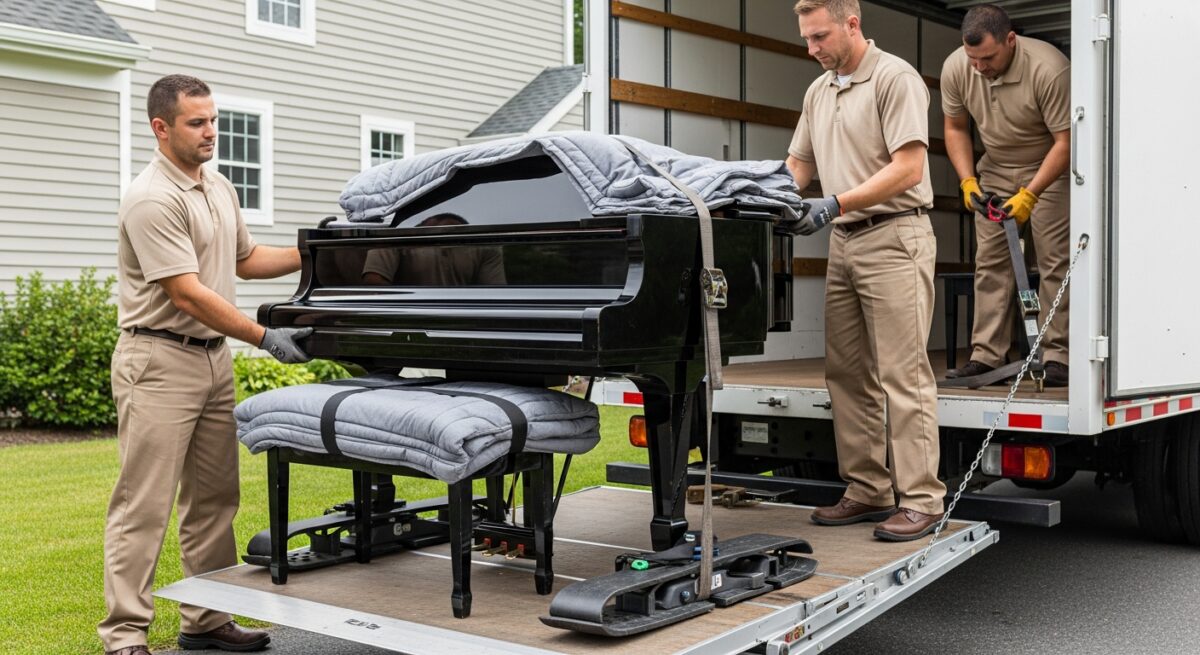
The piano is then prepared for transport. The movers remove the legs, lyre, and music rack from a grand piano. These parts are wrapped individually in furniture pads and stretch wrap. The body of the piano is encased in multiple layers of padding, including a specialized piano blanket or a custom-fitted padded cover. The keyboard lid is locked and taped shut to prevent it from opening during transit. For upright pianos, the movers secure the lid and lock the casters to prevent rolling.
Loading the piano onto the truck requires a hydraulic lift gate or a ramp rated for heavy loads. The piano is placed on a skid board or a piano board, which distributes the weight evenly and allows the movers to slide it smoothly. Inside the truck, the piano is strapped securely to the wall of the trailer using heavy-duty ratchet straps. It is never placed on top of other items or stacked beneath heavy boxes. The goal is to isolate the piano from vibration and shifting during the long drive.
Choosing a Reliable Cross Country Piano Mover
Not all moving companies are equipped to handle pianos. A general household mover might accept the job but lack the specialized training and equipment. The safest choice is a company that specifically advertises piano moving services or has a dedicated fine arts division. Look for movers who are members of the American Moving and Storage Association (AMSA) or the International Association of Movers (IAM). These organizations enforce standards for training and insurance.
Verify the mover’s licensing and insurance. For interstate moves, the company must have a USDOT number registered with the FMCSA. You can check this number on the FMCSA website to see if the company has a history of complaints or violations. Ask for a certificate of insurance that shows cargo coverage for the specific value of your piano. If the mover hesitates to provide this documentation, find another provider.
Read reviews on third-party sites like the Better Business Bureau, Yelp, and Google. Look for specific feedback about piano moves. A company that has successfully moved dozens of pianos across the country will have a track record of careful handling and on-time delivery. Avoid movers that require a large cash deposit upfront. Reputable cross country piano movers typically ask for a small deposit (10% to 20%) and collect the balance upon delivery.
In our guide on how to compare cross country moving quotes to save big, we explain how to evaluate estimates and spot hidden fees. The same principles apply to piano moves. Get at least three written estimates and compare the scope of services, not just the bottom line.
Insurance and Liability Protection
Insurance is arguably the most important part of a cross country piano move. The standard protection offered by most movers is called Released Value Protection. This is included at no extra charge, but it only covers 60 cents per pound per item. If your $15,000 grand piano weighs 800 pounds, the maximum payout under this plan is $480. That is far less than the cost of repairing a cracked soundboard or a damaged action.
Full Value Protection (FVP) is the better option for expensive instruments. Under FVP, the mover is liable for the replacement value of the piano if it is lost or damaged. The cost is typically 1% to 3% of the declared value. For a $15,000 piano, that means an additional $150 to $450 for the move. If you are moving a vintage Steinway or a custom-made instrument, consider purchasing separate inland marine insurance from a third-party insurer. This provides broader coverage and is not tied to the mover’s claims process.
Document the condition of your piano before the move with high-resolution photos and a video walkaround. Store these files in a cloud backup. If damage occurs, file a claim immediately with the mover and provide your documentation. Most movers require claims to be submitted within 90 days of delivery. If you have trouble with the claim, you can file a complaint with the FMCSA.
Preparing Your Piano for the Move
You can take several steps to make the move safer and potentially reduce costs. First, have your piano tuned and inspected by a qualified piano technician about two weeks before the move. The technician can identify any loose parts, sticky keys, or structural issues that might worsen during transit. This also gives you a professional assessment of the piano’s current value for insurance purposes.
Clear a path from the piano to the exit door. Remove rugs, furniture, and wall decorations that might obstruct the movers. Measure doorways, hallways, and stairwells to ensure the piano will fit. If the piano is on a second floor or higher, the movers may need to use a crane or a stair climber dolly, which adds time and cost. Discuss these logistics with the moving company during the estimate.
Do not attempt to disassemble the piano yourself. Piano disassembly is a skilled task that requires knowledge of the instrument’s internal mechanics. Let the professionals remove the legs, pedals, and lid. Your job is to secure the area and keep children and pets away from the work zone.
Frequently Asked Questions
How much does it cost to move a piano across the country?
The average cost ranges from $1,500 to $5,000 depending on piano size, distance, and access conditions. A small upright moving 1,000 miles might cost $1,200 to $2,000, while a grand piano moving 3,000 miles could cost $3,500 to $6,000.
Can I move a piano myself to save money?
It is not recommended. Pianos are heavy and unbalanced. DIY moving often results in damage to the piano, the flooring, or the movers themselves. Professional piano moving services include insurance that protects your investment.
How long does a cross country piano move take?
Transit time for a long distance move is typically 5 to 14 days depending on the route and the mover’s schedule. Some companies offer expedited delivery for an additional fee.
Do I need to tip piano movers?
Tipping is not required but is appreciated for good service. A typical tip is $20 to $50 per mover for a full-day job, or 10% to 15% of the total moving cost.
What happens if my piano is damaged during the move?
Document the damage immediately upon delivery. Notify the mover in writing and file a claim. If you have Full Value Protection, the mover must repair, replace, or reimburse you for the piano’s current market value.
For additional financial flexibility, you might explore options like car loan refinancing to free up cash for your relocation expenses. Lowering your monthly car payment can help cover the cost of professional piano moving services without straining your budget.
Moving a piano across the country is a significant investment, but it does not have to be a risky one. By understanding the cost structure, insisting on proper safety protocols, and securing adequate insurance, you can protect your instrument and your peace of mind. Work only with reputable cross country piano movers who specialize in this type of transport, and always get everything in writing. Your piano will arrive safely at your new home, ready to make music for years to come.