
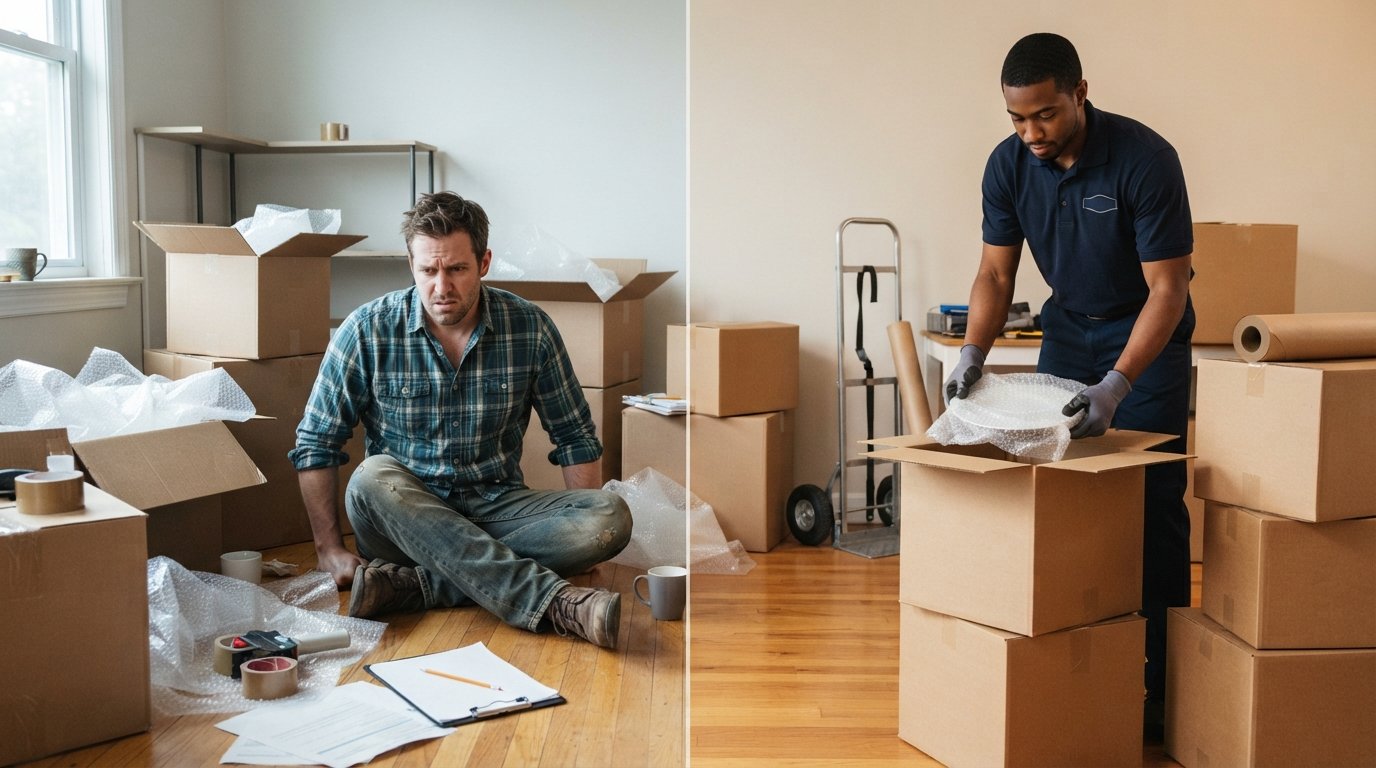
Professional Packers vs DIY Cost: Which Saves More?
Compare the real costs of professional packers vs DIY packing, including materials, time, and risk, to find the best value for your move.

By Nicole Walker
When planning a move, one of the first and most stressful decisions is how to handle the packing. Should you hire professional packers or rely on your own time, boxes, and bubble wrap? The answer is not as simple as comparing hourly rates. A thorough look at professional packers vs DIY cost reveals that the true expenses go far beyond the price tag on a moving quote. Your time, the risk of damage, the cost of materials, and even your insurance coverage all play a role. This guide breaks down the real numbers, hidden fees, and practical trade-offs so you can choose the approach that fits your budget and your peace of mind.
The Real Cost of DIY Packing: More Than Just Cardboard Boxes
At first glance, packing your own belongings seems like the obvious money-saver. You can collect free boxes from local stores, buy a few rolls of tape, and spend your evenings wrapping dishes in old newspaper. However, the true cost of DIY packing includes several factors that are easy to overlook. Let's break down the typical expenses you will face when you choose the do-it-yourself route.
First, materials add up quickly. A roll of quality packing tape costs around $4 to $6, and you will likely need five to ten rolls for a two-bedroom home. Bubble wrap, packing paper, and specialty boxes for dishes, wardrobes, and art can easily total $200 to $400 for a standard household. If you buy new boxes from a moving supply store, the cost can reach $1.50 to $3.00 per box, and a typical two-bedroom move uses 50 to 100 boxes. That's a baseline of $75 to $300 just for containers.
Second, there is the value of your time. Professional packers can pack a two-bedroom apartment in about six to eight hours. Doing it yourself, especially if you have never packed a full home before, can take 20 to 40 hours spread over several weeks. If you value your time at even $15 per hour, that's an opportunity cost of $300 to $600. For many families, that time is better spent on work, childcare, or simply reducing stress during a busy transition.
Third, consider the risk of damage. Without professional packing techniques, your glassware, electronics, and antiques are more vulnerable to breakage. A single cracked TV screen or shattered set of china can cost hundreds or thousands of dollars to replace. While you may save on the upfront packing fee, a DIY mistake can wipe out all of your savings in one accident. This is where professional packers vs diy cost becomes not just about money, but about protecting your belongings.
What Professional Packers Charge: A Detailed Look
Professional packing services typically charge by the hour, per item, or as a flat rate depending on the company and the size of your home. On average, you can expect to pay between $300 and $600 for a one-bedroom apartment, $500 to $900 for a two-bedroom home, and $1,000 to $2,000 or more for a four-bedroom house. These rates usually include materials, labor, and sometimes basic insurance coverage. The key is to request a detailed quote that lists exactly what is covered, so you are not surprised by hidden fees.
The hourly rate for professional packers ranges from $35 to $60 per hour per packer, with a typical team of two or three working together. For a full-service move, the packing crew will handle everything from wrapping furniture to boxing up your kitchen. They bring their own high-quality materials, which often include double-wall boxes, specialty cartons for mirrors and artwork, and paper or foam padding. This can save you the hassle of sourcing and assembling materials yourself.
One of the biggest advantages of hiring professionals is the speed and efficiency they bring. A trained team can pack a room in a fraction of the time it would take you, and they know how to use every inch of space to minimize the number of boxes. This reduces the total volume of your shipment, which can lower your overall moving cost if you are paying by weight or by the linear foot of truck space. In some cases, the savings on shipping weight alone can offset a portion of the packing fee.
Comparing the Bottom Line: A Side-by-Side Cost Breakdown
To make a fair comparison, let's look at a typical two-bedroom apartment move of about 1,500 miles. We'll estimate the costs for both DIY and professional packing, including materials, labor, and potential hidden expenses. The numbers below are based on national averages and can vary depending on your location and the company you choose.
- DIY Packing: Materials (boxes, tape, paper, bubble wrap) cost around $250, your time valued at $15/hour for 30 hours equals $450, and a 10% risk of damage on $2,000 of valued items averages $200. Total estimated cost: $900.
- Professional Packing: Full-service packing for a two-bedroom apartment averages $700, which includes materials and labor. With basic valuation coverage included, your out-of-pocket risk drops to near zero. Total estimated cost: $700.
- Hybrid Approach: You pack personal items and small, fragile things, and professionals handle the kitchen, books, and large furniture. This might cost $300 to $400 for the professional portion, plus $150 for your own materials and 10 hours of your time valued at $150. Total estimated cost: $600 to $700.
As this breakdown shows, the professional packers vs diy cost gap is often much smaller than people assume, and sometimes professional packing is actually cheaper when you factor in the value of your time and the cost of materials. The hybrid approach can be a smart compromise, giving you control over your most personal items while letting experts handle the heavy lifting. However, the decision also depends on your budget flexibility and your tolerance for risk.
Another factor to consider is the type of items you own. If you have a minimalist apartment with mostly clothes and books, DIY packing may be perfectly manageable. But if you have a large family home with a full kitchen, china cabinet, and home office, the sheer volume of fragile items makes professional packing a smarter financial and logistical choice. In our guide on professional packers and movers services for a stress-free move, we explain how these services can also reduce the physical strain and emotional burden of moving.
Hidden Costs and Savings: Insurance, Materials, and Time
When comparing professional packers vs diy cost, many people overlook the role of insurance. Most reputable moving companies offer basic valuation coverage, which is a minimal protection based on the weight of your shipment. For more comprehensive coverage, you can purchase additional liability insurance that covers the full replacement value of your items. If you pack yourself, the moving company may limit its liability for damage to items you packed, because they cannot verify that proper techniques were used.
This means that a DIY move can carry a significant financial risk. If a box of your dishes breaks because you didn't use enough bubble wrap, the mover is not responsible. In contrast, professional packers are trained to wrap items to withstand the rigors of transport, and their work is typically backed by the mover's insurance. That peace of mind is worth real money, especially for fragile or sentimental items. Before you decide, ask your moving company about their liability policy and how it applies to boxes packed by the homeowner versus those packed by their crew.
Another hidden cost is the rental of moving equipment. If you are doing a DIY move with a rental truck, you might need furniture dollies, moving blankets, and straps. These rentals add $30 to $100 to your total, and you still have to do the heavy lifting. Professional packers also use these tools, but they are included in the service fee. Additionally, the time you spend packing could be time you spend on other moving tasks, like transferring utilities, updating your address, or cleaning your old place. When you calculate the total cost of your move, be honest about the value of your own time.
When DIY Makes Sense: Budget-Friendly Scenarios
There are certainly situations where packing your own boxes is the better choice. If you are moving a small studio or a single room, the cost of professional packing might be more than your total moving budget. In that case, DIY packing can save you hundreds of dollars, and the time investment is manageable. Similarly, if you are a student or a first-time mover with little furniture and few fragile items, you may not need professional help.
Another scenario is when you have plenty of free time and you enjoy the hands-on process. Some people find packing to be a great way to sort and declutter their belongings before a move. If you are on a strict budget and can't afford professional services, a DIY move with careful planning and a solid checklist is entirely feasible. Just be sure to start early, use quality materials, and pack with care to minimize damage.
If you do choose DIY packing, consider using a service like FreeQuotes.Contractors to get multiple quotes for moving truck rentals and moving supplies. This platform connects you with local providers, helping you compare prices and find the best deals. Even if you pack yourself, you can still save money on the other aspects of your move, which is a smart way to balance cost and convenience.
When to Hire Professionals: High-Value Items and Tight Schedules
Professional packers are not just for the wealthy or the lazy. They are a practical solution for anyone with a high-value collection, a tight deadline, or a medical condition that prevents heavy lifting. If you have art, antiques, pianos, or large electronics, professional packers have the expertise and materials to protect them. They also have experience in disassembling and reassembling furniture, which is a task many DIY movers dread and often do incorrectly.
Time pressure is another major factor. If your move date is approaching and you haven't started packing, hiring professionals can save you from a sleepless week of frantic box-stuffing. Moving companies can often send a packing crew a day or two before the move, and they can pack your entire home in a single day. This is especially valuable for corporate relocations or military moves where the timeline is fixed. The cost of professional packing is often a small price to pay for avoiding the stress of last-minute chaos.
Finally, consider your physical health. Packing involves repetitive bending, lifting, and carrying, which can lead to back injuries or muscle strain. For older adults or those with chronic pain, hiring professional packers is not just a luxury but a safety measure. The peace of mind that comes from knowing your belongings are safely packed and your body is protected is worth the extra expense for many families.
How to Get Accurate Quotes for Packing Services
Once you've decided that professional packing might be worth the cost, the next step is to get accurate quotes. Start by requesting in-home or video surveys from at least three moving companies. This gives the movers a chance to see the volume of your belongings and provide a written estimate. Be wary of quotes given over the phone or via email without a visual assessment, as they can be wildly inaccurate.
Ask each company for a detailed breakdown of packing costs, including the hourly rate, the estimated number of hours, and the cost of materials. Some companies offer a flat fee for packing a certain number of rooms, which can be easier to budget for. Also, clarify whether the packing fee includes unpacking at your new home. Unpacking services are usually an additional cost, but they can be a huge time-saver on the other end.
When you compare quotes, don't just look at the total price. Consider the reputation of the company, the experience of the packers, and the insurance coverage they offer. A slightly higher quote from a well-reviewed company may be a better value than a cheaper quote from an unknown provider. To make this process easier, you can use a service like FreeQuotes.Contractors, which connects you with pre-vetted local contractors for home improvement and repair projects. While it focuses on home services, the same principle of comparing multiple vetted providers applies to moving companies.
Final Verdict: Making the Right Choice for Your Move
In the debate of professional packers vs diy cost, there is no one-size-fits-all answer. The right choice depends on your budget, your time, your physical ability, and the value of your possessions. For many people, a hybrid approach offers the best balance: pack your own clothes and personal items, and hire professionals for the kitchen, fragile items, and bulky furniture. This way, you save money while ensuring the most delicate parts of your move are handled by experts.
Remember that the cheapest option is not always the most cost-effective. A DIY move that results in broken items, a back injury, or days of lost work can end up costing you more than hiring professionals from the start. On the other hand, if you have a simple move and a flexible schedule, DIY packing can free up your budget for other priorities. Whichever route you choose, the key is to plan ahead, get multiple quotes, and understand exactly what you are paying for.
Ultimately, the goal is to make your move as smooth and stress-free as possible. Whether you decide to pack every box yourself or bring in a team of professionals, the peace of mind that comes from a well-executed move is priceless. Take the time to weigh the true costs, and you will make a decision that fits both your wallet and your life. FreeQuotes.Contractors