
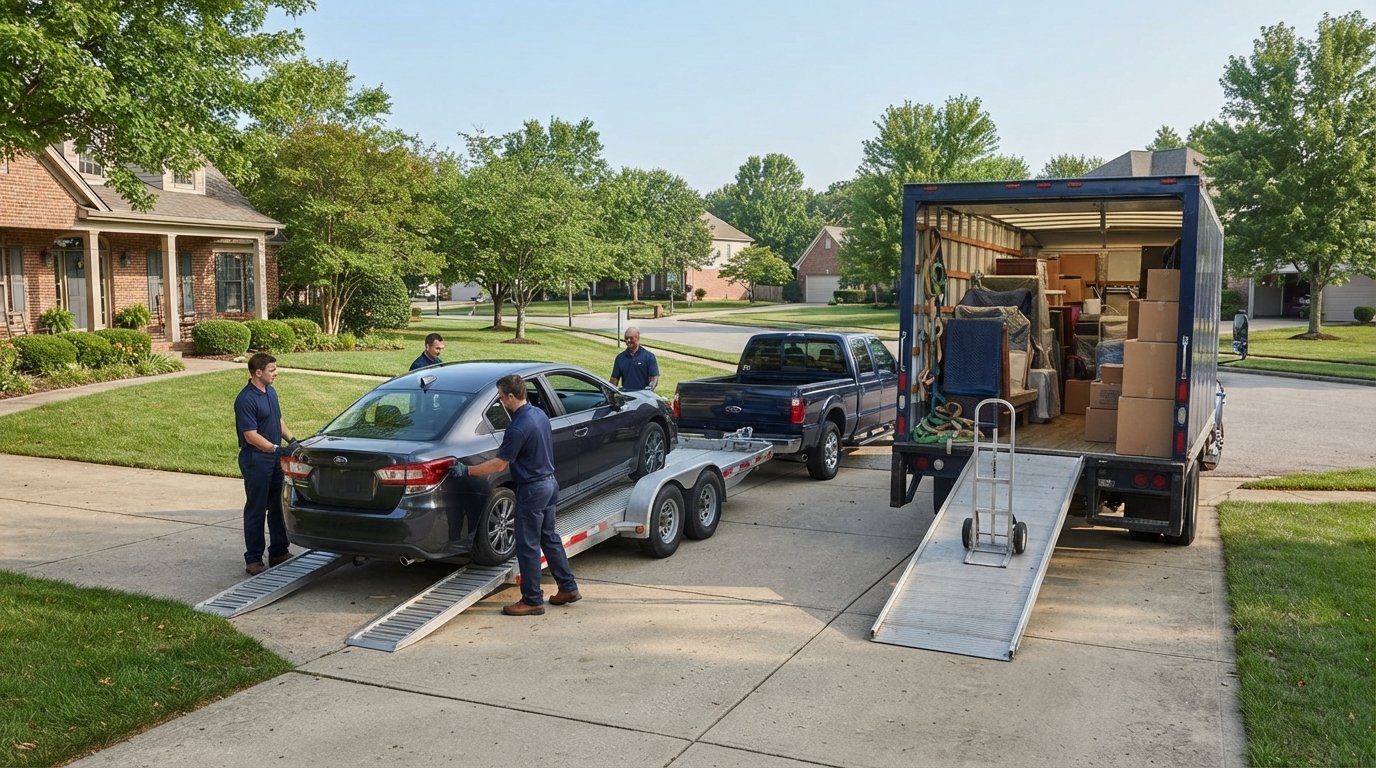
How to Ship a Car and Household Goods Together
Ship your car and household goods together with one coordinated plan. Learn how to align pickup, delivery, and costs for a smoother move.

By Michelle Carter
Moving is rarely a single, simple task. It is a sequence of decisions, deadlines, and logistics that all have to line up at the same time. When you own a vehicle and an entire home full of furniture, the challenge doubles. You need to get your car to the new address, and you need your beds, sofas, boxes, and appliances to arrive safely too. Trying to coordinate two separate companies on two separate schedules often leads to missed windows, surprise fees, and a lot of unnecessary stress. That is why more people are asking how to ship a car and household goods together, using one coordinated plan instead of two disconnected ones.
The good news is that combining vehicle transport with a household move is not only possible, it can also be more affordable and far less chaotic than handling each piece separately. The key is understanding how the two services interact, what rules apply, and where the real risks hide. This guide walks through the entire process, from choosing the right providers to preparing your car and your home for pickup, so you can manage a combined move with confidence.
Why Combining Car Shipping and Household Moving Makes Sense
When you hire two unrelated companies, you create two timelines that rarely match. The car carrier might need your vehicle on a Tuesday, while the household movers want to load on a Thursday. If you are already at your new home, you may have to fly back or pay someone to hand over the keys. Every extra trip, hotel night, and rescheduled pickup adds cost and frustration. Combining the services under one coordinated schedule removes most of that friction because the same move plan covers both your vehicle and your belongings.
Cost is another factor. Many people assume that shipping a car and moving household goods together requires two full-price contracts. In reality, some full-service moving companies and auto transport brokers offer bundled pricing or at least a shared pickup window that reduces labor and travel charges. Even when the pricing stays separate, you save on ancillary costs: fewer days of rental cars, fewer storage fees, and less time away from work. The savings are not always obvious on the first quote, so it helps to compare the total cost of a combined move against the total cost of two independent moves.
There is also the matter of accountability. When two companies point fingers at each other after a delay or a scratch, you are stuck in the middle. A single point of contact for both the vehicle and the household goods means one company owns the schedule. If something slips, you make one call, not three. That alone is worth a lot during an already demanding life event.
Finally, combined moves are simply easier to plan. You build one master checklist, one budget, and one communication thread. Instead of juggling two sets of paperwork, you track a single move date and a single delivery window. For families, renters, and anyone relocating for work, that simplicity can be the difference between a smooth transition and a month of chaos.
How Car Shipping and Household Moving Actually Work Together
Understanding the mechanics helps you ask the right questions. Household movers typically load your belongings into a moving truck or a moving container, then drive or ship that load to your destination. Car shipping companies use one of two methods: open transport, where your vehicle rides on a multi-car carrier exposed to the weather, or enclosed transport, where it travels inside a covered trailer. The two services can run in parallel, but they rarely share the same truck unless you hire a specialized full-service mover that owns both types of equipment.
In a coordinated move, the timeline usually looks like this. First, you book a moving company for your household goods and a car carrier for your vehicle, ideally through a single provider or a platform that connects you with both. Next, you schedule the vehicle pickup for the same day or the day before the household load. The car is loaded onto the carrier, and the household goods are loaded onto the moving truck. From there, each travels independently to the destination, but both are tracked under one move plan. Delivery windows are set so that you can receive both shipments without waiting around for weeks.
This parallel structure is why combining services works. You are not forcing one truck to carry everything, which is usually impossible for long distances. Instead, you are aligning two specialized services under one schedule. That alignment is the real product you are buying when you ask how to ship a car and household goods together.
If you want a deeper look at how vehicle transport providers operate behind the scenes, our guide on how car transportation companies work explains the dispatch, brokerage, and carrier networks that make pickup and delivery possible.
Choosing the Right Provider for a Combined Move
Not every moving company handles vehicles, and not every auto transport broker can coordinate a household move. Your first job is to find a provider or platform that can manage both sides of the equation. Full-service movers with their own car carriers are the simplest option, but they are not available in every market. The next best choice is a relocation platform that connects you with vetted movers and vehicle shipping specialists under one quote request.
When you evaluate providers, look for these traits:
- Licensing and insurance for both household goods and vehicle transport, with proof available on request.
- Guaranteed pricing or clear, written estimates that separate line items for the move and the car shipment.
- Experience with combined moves, including references or case examples from similar relocations.
- Responsive customer support, ideally available outside standard business hours.
- Clear delivery windows and a documented process for delays, damage claims, and rescheduling.
Do not assume that the cheapest quote is the best one. Lowball estimates often hide fees for fuel surcharges, stair carries, long carries, or storage. Ask each provider to explain exactly what happens if the car carrier arrives before the moving truck or vice versa. A good provider will have a standard answer, not a vague promise.
It also helps to ask whether the company uses its own drivers or subcontracts. Subcontracting is common and not inherently bad, but it means more parties in the chain. If the provider cannot tell you who will actually pick up your car and your furniture, keep looking.
Preparing Your Vehicle for Shipment
Your car needs specific preparation before it is loaded onto a carrier. Most auto transport companies require the vehicle to be operable, meaning it can be driven on and off the trailer. If your car does not run, you may need a winch-equipped carrier, which costs more and must be booked in advance. Clean the car inside and out, remove personal items, and document its condition with photos and a written inventory before pickup.
Personal belongings left in the car are a common problem. Most carriers prohibit items in the vehicle for insurance and weight reasons, and anything left inside may not be covered if it is damaged or stolen. Treat the car as cargo, not as a moving box. If you have small valuables, keep them with you or pack them with your household goods under the mover's inventory.
Other preparation steps include:
- Checking tire pressure, battery charge, and fluid levels so the car can be moved without issues.
- Disabling any alarm system or providing the code to the driver.
- Removing toll transponders and parking stickers that could trigger charges later.
- Leaving only the ignition key and a spare with the driver, not the entire keychain.
- Confirming the pickup address is accessible to a large carrier truck, not just a passenger car.
If your street is narrow, tree-lined, or has low clearance, tell the carrier in advance. Drivers often need extra space to load and unload, and a last-minute access problem can delay the entire shipment.
Preparing Your Household Goods for a Combined Move
Household preparation overlaps with any normal move, but a combined move adds a few wrinkles. Because the car and the furniture may travel on different schedules, you need to label everything clearly and keep an inventory that matches the mover's paperwork. Start by decluttering. Every item you do not move is money saved on weight, volume, and packing materials. Donate, sell, or recycle what you no longer need before the movers arrive.
For items you keep, decide what you pack yourself and what the movers will handle. Professional packing services are worth the cost for fragile items, electronics, and large furniture. If you pack yourself, use sturdy boxes, double-wall corrugated for heavy items, and plenty of cushioning. Label each box with its destination room and a brief contents list. Keep a master inventory that includes high-value items, serial numbers, and photos.
Separate your essentials from the rest. Create a personal bag or box with documents, medications, chargers, toiletries, and a change of clothes. This box travels with you, not on the truck. It should also include the paperwork for both the car shipment and the household move, including bills of lading, insurance certificates, and contact numbers.
If your move includes storage, confirm whether the storage unit is climate-controlled. Electronics, wooden furniture, and musical instruments can warp or crack in uncontrolled environments. Ask the provider whether the car and the household goods can be stored at the same facility, which simplifies pickup and delivery.
Coordinating Pickup and Delivery Schedules
The single biggest risk in a combined move is a schedule mismatch. Your car might be ready for pickup on a Monday, but the household movers cannot load until Wednesday. Or the car carrier might deliver two weeks before the moving truck arrives. To avoid these gaps, build a shared calendar with the following milestones:
- Confirm the move date and the vehicle pickup date with both providers in writing.
- Set a delivery window for the household goods and a separate window for the car.
- Identify who will receive each shipment if you cannot be present.
- Arrange temporary parking or storage if one shipment arrives early.
- Exchange contact information for the dispatcher, driver, and your move coordinator.
If you are driving to your new home instead of flying, you may be able to drop the car off at the carrier's terminal and pick it up at the destination terminal. This is often cheaper than door-to-door service and gives you more control over timing. Terminal-to-terminal shipping works well when you are flexible about pickup and delivery dates.
Ask both providers what happens if a delivery is delayed by weather, traffic, or mechanical problems. Reputable companies have contingency plans, such as re-routing or temporary storage. Get those contingencies in writing so you are not negotiating under pressure.
Understanding Costs and Avoiding Surprise Fees
Combined moves are priced in different ways. Some providers bundle the services into a single quote, while others keep the household move and the car shipment as separate line items. Either way, you should see a clear breakdown of charges for labor, transportation, fuel, packing materials, insurance, and any special handling. Ask for the total cost in writing before you sign anything.
Common add-on fees include:
- Stair carries or long carries if the truck cannot park close to your door.
- Shuttle service if your street cannot accommodate a large moving truck.
- Storage fees if delivery is delayed or you need temporary holding.
- Inoperable vehicle fees if your car cannot be driven onto the carrier.
- Expedited or guaranteed delivery windows, which cost more than standard windows.
If you are also planning home repairs or upgrades before or after the move, it helps to line up contractors early. Platforms like FreeQuotes.Contractors connect homeowners with pre-vetted local professionals for projects such as roofing, HVAC, windows, plumbing, and painting, which can be useful when you are settling into a new property and need work done quickly.
Finally, review the insurance coverage for both the vehicle and the household goods. Moving companies typically offer released-value protection at no extra cost and full-value protection for an additional fee. Auto carriers are required to carry liability insurance, but it may not cover personal items inside the car. Know what is covered before the truck pulls away.
Managing Risk and Handling Problems
Even well-planned moves can hit snags. The car carrier might be delayed by a snowstorm in the mountains, or the moving truck might be held up at a weigh station. The difference between a minor inconvenience and a major crisis is how quickly you can reach someone who can solve the problem. Before you book, confirm that the provider offers 24/7 support and that you have a direct number for the dispatcher, not just a general customer service line.
Document everything. Take photos of the car and the household goods before loading. Keep copies of all contracts, estimates, and correspondence. If damage occurs, report it immediately in writing and file a claim according to the provider's process. Most claims have strict deadlines, sometimes as short as a few days after delivery, so do not wait.
If you are moving internationally, the complexity increases. Customs clearance, import duties, and quarantine rules can affect both your vehicle and your household goods. Work with a provider that has experience in international relocation and can guide you through the paperwork. Ask about port fees, container shipping, and whether your car needs to be modified to meet local safety or emissions standards.
For domestic moves, the biggest risks are schedule slips and damage. Mitigate them by choosing a provider with guaranteed pricing, professionally trained movers, and a track record of on-time delivery. Read reviews, check licensing, and trust your instincts. If a quote seems too good to be true, it probably is.
Frequently Asked Questions About Combined Shipping
Can I ship my car and household goods in the same truck?
In most cases, no. Household moving trucks are not equipped to carry vehicles, and auto carriers are designed specifically for cars. The exception is a specialized full-service mover that owns both types of equipment and can coordinate a single pickup. For long-distance moves, the two shipments usually travel separately but under one schedule.
How far in advance should I book a combined move?
For domestic moves, book four to six weeks in advance, especially during peak season from May to September. For international moves, start three to six months ahead to allow time for customs, shipping schedules, and documentation. Last-minute bookings are possible but often cost more and offer fewer options.
Is it cheaper to ship my car and household goods together?
It can be, but not always. The savings usually come from reduced ancillary costs, such as rental cars, hotels, and storage, rather than from a discounted rate on the transport itself. Compare the total cost of a combined move against two separate moves to see the real difference.
What if my car arrives before my furniture?
This is common. Arrange temporary parking or short-term storage for the car, or ask the carrier to hold it at the terminal for a few days. Some carriers charge a daily storage fee after a grace period, so confirm the policy in advance.
Can I pack personal items in my car?
Most auto carriers prohibit personal items in the vehicle for insurance and safety reasons. If items are allowed, they are usually limited to a small, secured box and may not be covered by insurance. Pack valuables with your household goods instead.
Final Thoughts on Coordinating a Combined Move
Shipping a car and household goods together is less about finding a magic truck that carries everything and more about aligning two specialized services under one plan. When you choose a provider that can coordinate both, prepare your vehicle and your home properly, and keep your paperwork organized, the process becomes manageable. Start early, ask detailed questions, and get every promise in writing. With the right approach, your car and your belongings can arrive at your new home on schedule, in good condition, and without the chaos of two disconnected moves. Get connected with movers who can help with both your vehicle and your household goods, and let the professionals handle the heavy lifting while you focus on settling in.