
How to Move a Hot Tub or Above Ground Pool Safely
Moving a hot tub or above ground pool takes planning, but it can be done safely. Call (833)-484-8675 for expert mover referrals and a free quote.

By Kevin Morris
Moving a hot tub or an above ground pool is one of the most intimidating tasks a homeowner can face during a relocation. These are not pieces of furniture that can be wrapped in a blanket and carried out the front door. They are heavy, water-dependent structures with electrical and plumbing connections, and in the case of a hot tub, they can weigh well over 800 pounds even when completely drained. The good news is that both items can be relocated successfully when you plan ahead, understand the risks, and bring in the right help at the right time. This guide walks you through everything from the initial feasibility check to the final installation at your new home.
Deciding Whether to Move It or Sell It in Place
Before you pick up a single tool, ask yourself an honest question: is moving this hot tub or pool actually worth it? In many cases, the answer is no. A used above ground pool that cost $2,000 new may only be worth $300 to $600 on the secondary market, and the cost of dismantling, transporting, and reinstalling it can easily exceed that amount. Hot tubs are even trickier because their internal components (pumps, heaters, control boards) are sensitive to jostling, and a single cracked manifold can turn a simple move into a $1,500 repair.
Several factors should push you toward selling in place rather than moving. If the hot tub is more than seven years old, if the pool liner is already faded or patched, or if your new home has no clear pathway for a 400-pound shell, selling locally is almost always the smarter financial decision. Buyers on Facebook Marketplace, Craigslist, and local classifieds will often pay cash and handle the removal themselves, which saves you both the labor and the liability.
On the other hand, moving makes sense when the item is relatively new (under five years), when it is a premium model with a replacement cost above $8,000, or when your new property already has the electrical and plumbing infrastructure waiting. If you are relocating a short distance and can borrow a flatbed trailer, the economics shift in favor of moving. Before you commit, get a written estimate from a specialty mover so you can compare the transport cost against the resale value. If you are still weighing whether to hire professionals for the broader move, our guide on hiring furniture movers versus DIY moving can help you decide where to draw the line between doing it yourself and bringing in a crew.
Assessing Feasibility and Planning the Route
Once you decide to move the hot tub or pool, the next step is a realistic feasibility assessment. Walk the entire path the item will travel: from its current location, through the yard, out the gate, down the driveway, and onto the truck. Measure every choke point. A standard hot tub shell is 7 to 8 feet wide, and many side gates are only 36 inches. If the tub will not fit through the gate upright, you may need to tilt it on its side, which requires at least two strong people and a furniture dolly rated for the weight.
For above ground pools, the challenge is different. The wall is typically coiled aluminum or steel, and the liner is a large vinyl sheet. Both can be transported, but the wall must be kept from kinking and the liner must be kept from puncturing. Measure the length of the wall when coiled; a 24-foot round pool produces a coil roughly 8 to 10 feet long and 2 feet in diameter. That coil will not fit in the back of a standard SUV, so you will need a pickup truck, a trailer, or a professional moving truck with a long bed.
Also consider the destination. Does your new home have a level pad for the hot tub? Is there a 240-volt electrical service nearby, or will you need to hire an electrician? For an above ground pool, is the new yard level within two inches across the entire footprint? If not, you will need to grade the site before installation. Planning these details before the move prevents the frustrating scenario of paying for transport only to have the item sit on a trailer because the new site is not ready. For homeowners planning broader renovations or site prep, resources like ContractorHomeQuotes can help you find and compare local contractors for electrical, plumbing, and grading work.
Disconnecting Electrical and Plumbing Components Safely
This is the step where most DIY moves go wrong. Hot tubs and above ground pools are connected to both electricity and water, and both must be disconnected by a qualified professional in most jurisdictions. Do not attempt to cut live wires or unscrew plumbing fittings while the system is pressurized. The risks include electrocution, flooding, and voiding your homeowner insurance policy if something goes wrong later.
For a hot tub, the electrical disconnect is usually a dedicated 240-volt circuit with a GFCI breaker. An electrician will shut off the breaker, verify there is no current with a multimeter, and then disconnect the wiring at the control pack. They will cap the wires and label them for reconnection. On the plumbing side, you will need to drain the tub completely, remove the drain valve, and blow out the lines with a shop vac to prevent residual water from freezing or leaking during transport. If your tub has a built-in ozonator or UV sanitizer, those components should be removed and packed separately.
For an above ground pool, the plumbing is simpler but still requires care. Shut off the pump and filter, disconnect the hoses, and drain the pool completely. Remove the skimmer and return fittings, and store them in a labeled bag. The pump and filter should be drained, dried, and transported upright to prevent motor damage. If your pool has a gas or electric heater, that unit must be disconnected by a licensed technician. In both cases, take photos of every connection before you disconnect anything. Those photos will be invaluable when you reassemble the system at your new home.
Dismantling and Preparing the Hot Tub for Transport
Once the utilities are disconnected, the hot tub itself must be prepared for the road. Start by removing the cabinet panels and the access door. This reduces weight and prevents the panels from cracking. Next, remove any steps, cover lifters, and headrests; these are fragile and should be packed in the moving truck with your household goods. If the tub has a built-in stereo or LED lighting system, label the wiring before you disconnect it.
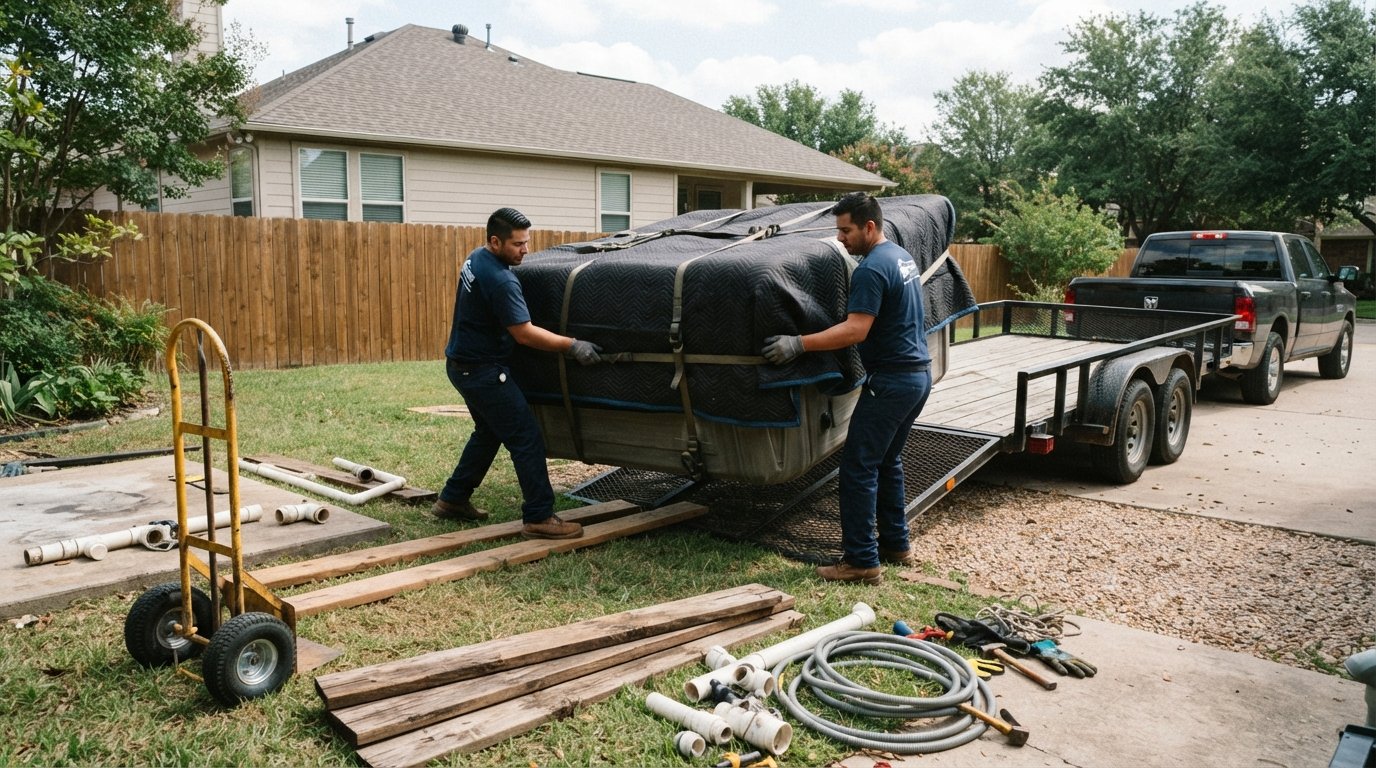
The shell itself should be wrapped in moving blankets and then secured with shrink wrap or plastic stretch film. Pay special attention to the corners, which are the most likely to chip. If you are transporting the tub on its side, build a simple wooden frame or use heavy-duty furniture straps to keep it from rolling. Never transport a hot tub on its side without support; the weight of the shell can cause the acrylic to flex and crack. A flatbed trailer with a plywood deck is the ideal transport vehicle, but a box truck with a ramp can work if the tub is properly strapped and the ramp is rated for the weight.
Here is a quick checklist for hot tub preparation:
- Drain the tub completely and blow out all water lines.
- Disconnect and cap electrical wiring at the control pack.
- Remove cabinet panels, steps, cover, and headrests.
- Wrap the shell in moving blankets and shrink wrap.
- Strap the tub to a furniture dolly or trailer deck with ratchet straps.
- Label all removed parts and keep small hardware in a sealed bag.
After the tub is wrapped and strapped, do a final walkaround. Check that no water is dripping from the drain line, that all straps are tight, and that the tub cannot shift more than an inch in any direction. If you are moving in cold weather, add a layer of foam board between the tub and the trailer deck to prevent the acrylic from becoming brittle and cracking.
Dismantling and Crating an Above Ground Pool
Above ground pools are more forgiving than hot tubs, but they still require careful dismantling. Start by draining the pool completely. Once empty, remove the top rails, uprights, and bottom tracks. Label each piece with a marker or masking tape so you know where it goes at the new house. The wall is the most delicate component: as you unbolt it from the bottom track, roll it slowly and evenly. Do not let it kink. Two people should work together, one on each end, to keep the coil uniform.
Once the wall is coiled, secure it with ratchet straps or heavy-duty rope at three points. Then wrap the entire coil in moving blankets and shrink wrap. The liner should be folded, not rolled, and placed in a sturdy box or plastic bin. Never store a liner in a black plastic bag in the sun; the heat will cause the vinyl to degrade. If the liner is more than three years old, consider replacing it rather than reinstalling it, since old liners become brittle and are prone to tearing during reinstallation.
The pool frame components (top rails, uprights, tracks) should be bundled by size and wrapped in plastic. Use a permanent marker to label each bundle. If you are moving a pool that uses resin components, they are lighter but more brittle than steel; handle them with care. All screws, bolts, and clips should be placed in a labeled plastic bag and taped to the largest bundle. When you arrive at the new home, having everything labeled will save you hours of guessing.
For transport, the coiled wall can be laid flat on a trailer or in the bed of a pickup truck. Do not stand it upright, as it can bend or fall. Place the liner box and hardware bag on top of the coil, then strap everything down. If you are using a professional moving truck, tell the crew in advance that you have a large coil and a heavy hot tub shell. They may need to load these items first to maximize space.
Coordinating Specialty Movers for Oversized Outdoor Items
Most general moving companies will not touch a hot tub or an above ground pool. These items require specialized equipment, additional insurance, and sometimes a separate truck. That is why coordinating specialty movers is often the smartest part of the entire process. A specialty mover will have a flatbed trailer with a winch, furniture dollies rated for 1,000 pounds or more, and experience strapping irregular shapes. They will also carry cargo insurance that covers the item during transit, which your standard homeowner policy may not.
When you request quotes, be specific about what you are moving. Tell the company the exact dimensions, weight, and condition of the hot tub or pool. Ask whether they have moved similar items before and whether they will disconnect and reconnect the electrical components (most will not; you will need a separate electrician). Get the quote in writing, and confirm whether the price includes stairs, tight gate access, or a long carry. These factors can add hundreds of dollars to the final bill.
If you are planning a long-distance move, ask whether the hot tub will be shipped on a dedicated truck or consolidated with other household goods. Consolidated shipments are cheaper but take longer and involve more handling. For a high-end hot tub, the extra cost of a dedicated truck is usually worth it. For an above ground pool, consolidation is fine as long as the coil is properly crated. Moving.Homes can connect you with movers who specialize in oversized outdoor items, and you can request a free quote in minutes by calling (833)-484-8675 or filling out the online form. The platform matches you with vetted professionals who offer guaranteed pricing and 24/7 support, so you are not left guessing whether your tub will arrive in one piece.
Loading, Securing, and Transporting the Items
Loading day is where preparation pays off. If you are using a professional crew, they will handle the heavy lifting, but you should still supervise. Make sure the hot tub is loaded on a flat, reinforced surface. If it is going into a box truck, it should be placed on the floor, not on top of other items. Use ratchet straps to secure it to the truck's tie-down rings, and place moving blankets between the tub and any hard surfaces. Never use bungee cords; they stretch and fail. Ratchet straps with a working load limit of at least 1,500 pounds are the minimum for a hot tub.
For the above ground pool, the coiled wall should be laid flat on the floor of the truck or trailer. Do not stand it on edge. Place the liner box and hardware bag on top, then strap the entire bundle down. If you are transporting the pool in an open trailer, cover it with a tarp to protect it from rain and road debris. Check the straps every 50 miles or so during a long drive; vibration can loosen them.
During transport, avoid sudden stops and sharp turns. The weight of a hot tub can shift if it is not properly secured, and a shifting load is dangerous. If you are driving a rental truck, remember that the vehicle will handle differently with 800 pounds of dead weight in the back. Allow extra stopping distance and take corners slowly. If you are towing a trailer, check the tire pressure and hitch connection before you leave, and again at every fuel stop.
Reinstallation and Final Checks at the New Home
Once you arrive, do not rush the reinstallation. For a hot tub, the first step is to prepare a level, reinforced pad. A concrete slab is ideal, but a compacted gravel base with a pressure-treated wood frame can work for lighter tubs. The pad must be level within half an inch across the entire footprint; any rocking will stress the shell and cause leaks. Once the pad is ready, set the tub in place, reconnect the plumbing, and have a licensed electrician reconnect the wiring. Fill the tub with water, run the pump, and check for leaks before you add chemicals.
For an above ground pool, the installation is more labor-intensive. You will need to level the ground, assemble the bottom track, uncoil the wall, and install the liner. This is a two- or three-person job that can take a full weekend. If the ground is not level, the pool will lean, and the wall can buckle when filled. Many homeowners hire a professional installer for this step, especially if the pool is larger than 18 feet in diameter. The cost of installation is usually a few hundred dollars, which is cheap insurance against a collapsed pool.
After everything is reassembled, run a full system test. For the hot tub, check the heater, pump, jets, and control panel. For the pool, check the filter, skimmer, and return fittings. Look for leaks at every connection. If you labeled your parts and took photos during disassembly, this process will be much faster. If something does not fit, do not force it; consult the manufacturer's manual or call a professional.
Moving a hot tub or above ground pool is never a simple task, but it is manageable when you break it into stages: decide, disconnect, dismantle, transport, and reinstall. The most common mistakes are skipping the feasibility check, attempting electrical work without a license, and failing to secure the load properly. By avoiding those pitfalls and bringing in specialty movers for the heavy lifting, you can protect your investment and enjoy your hot tub or pool at your new home. If you are still in the planning phase, start by getting a quote from a reputable moving company. A few minutes on the phone can save you thousands of dollars in damage and stress.