
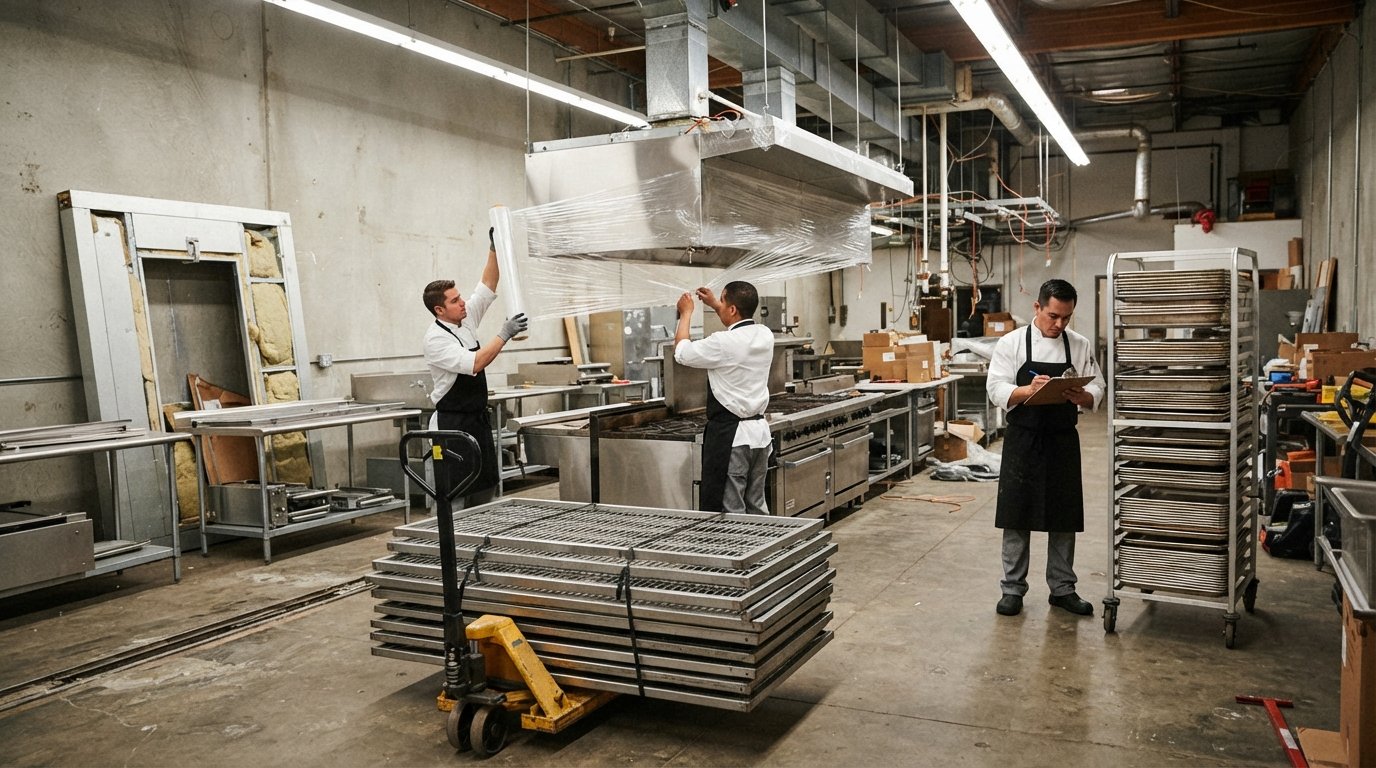
How to Move a Commercial Kitchen Without Losing Operating Days
Move your commercial kitchen with zero lost operating days using phased planning. Call 8334848675 for expert relocation guidance.

By Brandon Hall
Your walk-in cooler is full, your line cooks are prepping for the dinner rush, and somewhere in the back of your mind a countdown clock is ticking: the lease on your current space ends in six weeks, and the new location is still a shell of studs and concrete. For restaurant owners, ghost kitchen operators, caterers, and institutional food service directors, a commercial kitchen relocation is not just a logistics puzzle. It is a revenue event. Every day your burners are cold, you are still paying rent, insurance, payroll, and loan payments while zero covers are being sold. The difference between a move that costs you two service days and one that costs you two weeks is almost never luck. It is sequencing.
The good news is that a commercial kitchen can be relocated with zero lost operating days if you treat the project like a military operation rather than a weekend chore. That means moving in phases, duplicating critical systems, pre-commissioning the new space before you vacate the old one, and keeping a small production capability alive at all times. This guide walks through the exact framework used by multi-unit restaurant groups and commissary kitchens to pull off a seamless transition, from the first site survey to the first plate served at the new address.
Start With a Capacity Audit, Not a Packing List
Most moving guides tell you to buy boxes and label them. That advice is useless for a commercial kitchen because your equipment is not the hard part. The hard part is capacity. Before you touch a single sheet pan, you need to document exactly how much production volume your current kitchen handles on a normal day: covers served, prep pounds processed, bake cycles completed, dishwashing throughput, and refrigeration cubic feet in use. This baseline becomes the specification for your new space and the benchmark for your temporary operations.
Walk through your kitchen during a live service and write down every piece of equipment that touches food, every utility connection, and every workflow that would stop if a single item disappeared. You will quickly realize that only a handful of assets are truly load-bearing for revenue: your primary cooking line, your refrigeration, your dish machine, and your POS or order routing system. Everything else can be staged, rented, or temporarily outsourced. That distinction is what allows you to phase a move instead of shutting down.
As you audit, separate your equipment into three tiers:
- Tier 1 (Revenue critical): Primary range or fryer line, walk-in or reach-in refrigeration, dish machine, POS terminals, and any specialized equipment that defines your menu (combi oven, blast chiller, wok range).
- Tier 2 (Support): Prep tables, mixers, slicers, shelving, smallwares, and storage racks that can be replaced with temporary rentals for a few weeks.
- Tier 3 (Deferrable): Back-office furniture, decorative fixtures, seasonal equipment, and anything that can sit in storage without affecting service.
Once this list exists, you can calculate your true minimum viable kitchen. That is the smallest configuration of Tier 1 equipment that lets you keep selling food. Your entire relocation plan will be built around keeping that minimum viable kitchen running at all times, either at the old site, the new site, or a temporary third location.
Build a Parallel Kitchen Before You Dismantle the Old One
The single biggest mistake in commercial kitchen moves is the sequential approach: shut down, pack, move, unpack, reopen. That approach guarantees lost operating days because there is no point in the sequence where you can actually cook. The alternative is a parallel approach, where the new kitchen reaches partial functionality before the old kitchen is decommissioned. This requires overlapping rent or a temporary staging space, but the extra cost is almost always less than the revenue you would lose during a shutdown.
To build a parallel kitchen, you need to negotiate your new lease with a fit-out period that starts well before your old lease ends. Aim for at least 30 to 45 days of overlap for a full-service restaurant, and 14 to 21 days for a smaller operation. During that window, your priorities are utilities, health department approval, and equipment installation. Gas, electrical, and plumbing connections must be inspected and certified before any equipment can be fired up, and the health department will not issue a permit to operate until those systems pass. If you are also moving across state lines, factor in additional time for new business licenses, food handler certifications, and sales tax registration.
This is also the stage where professional coordination pays for itself. If you would rather not manage utility scheduling, rigging, and certificate-of-occupancy paperwork while also running dinner service, you can compare vetted commercial movers through a platform like FreeQuotes.Contractors, which connects business owners with pre-screened local contractors and specialty trades. The goal is to have your new kitchen pass its final inspection while your old kitchen is still producing revenue, so that the day you close the old doors, the new ones are already open.
Phase the Move Around Your Slowest Service Windows
Even with a parallel kitchen, you will eventually need to physically move Tier 1 equipment. The trick is to schedule each move during the lowest-revenue window in your operating week and to keep at least one production capability alive. For most restaurants, that means moving during a Monday or Tuesday after a weekend brunch, or during a scheduled closure that you would have taken anyway (a deep clean day, a staff training day, or a holiday).
Break the move into discrete phases, each of which ends with a functional kitchen:
- Phase 1: Move Tier 3 items (storage, back office, seasonal equipment) during normal operating days using a small crew and a box truck. No service impact.
- Phase 2: Move Tier 2 items and install temporary rentals at the new site. Keep the old kitchen fully operational.
- Phase 3: Move Tier 1 equipment during a planned 24 to 48 hour closure, and immediately commission the new kitchen. If the new kitchen cannot be fully commissioned in that window, use a rented temporary kitchen or a commissary partner to bridge the gap.
- Phase 4: Move remaining inventory, smallwares, and POS data, then run a soft-open service at the new location before announcing the move publicly.
The key insight is that only Phase 3 carries real revenue risk, and that risk can be reduced to a single day or eliminated entirely with a temporary kitchen. Many cities have commissary kitchens, food truck hubs, or church kitchens that rent by the day, and a licensed mobile kitchen trailer can keep you serving while your permanent line is being installed. If you plan for that bridge capacity in advance, you can turn a two-week shutdown into a zero-day transition.
If you need help sourcing the right moving crew or specialty riggers for the heavy equipment phase, a service like choosing the right van movers can walk you through what to look for in a commercial mover, including insurance certificates, equipment-specific experience, and after-hours availability.
Protect Food Safety and Inventory Through the Transition
Health inspectors do not pause their standards because you are moving. In fact, a relocation is one of the highest-risk moments for a food service operation because temperature control, handwashing, and pest exclusion are all disrupted at once. The safest approach is to run your inventory down to near-zero before the Tier 1 move, then restock at the new site after the health department has signed off on the new kitchen.
For refrigerated and frozen inventory that cannot be sold down, arrange for refrigerated transport or a temporary cold storage unit at the new site. Never move a walk-in cooler full of food on a flatbed truck in summer. If you must transport cold inventory, use a licensed refrigerated carrier and keep a temperature log for every container. Your local health department may also require a formal plan for how you will maintain food safety during the move, so ask your inspector early.
Pest control is the other hidden risk. When equipment is disconnected and walls are exposed, rodents and insects can move freely. Schedule a pest inspection and treatment at both the old and new sites before equipment is reinstalled, and seal all wall penetrations around gas, water, and electrical lines. A single failed inspection at the new location can cost you more operating days than the move itself.
Coordinate Utilities, Permits, and Staffing in Parallel
Commercial kitchen equipment is not plug-and-play. A 60-inch range may need a 1-inch gas line with a specific pressure rating, a 240-volt circuit, and a dedicated exhaust hood with fire suppression. If any of those systems are not ready on move day, your equipment cannot legally operate. That is why utilities and permits should be your first calls, not your last.
Create a single master schedule that shows every dependency: gas connection, electrical panel upgrade, hood installation, fire suppression certification, health inspection, business license transfer, and staff training at the new site. Share this schedule with your general contractor, your equipment installer, your mover, and your health inspector so everyone is working from the same timeline. A one-day delay in a hood inspection can cascade into a one-week delay in reopening, so build in buffer days wherever possible.
Staffing is the other parallel track. Your team needs to know where to report, when to report, and what to do during the transition. Some employees can help with packing and setup, but you should not rely on your line cooks to also be your moving crew. Bring in temporary labor or professional movers for the heavy lifting so your kitchen staff stays focused on food quality. If you are moving across state lines, also check whether your existing employees can legally work at the new location and whether you need to register as an employer in the new state.
Run a Soft Open Before You Announce the Move
The final step in protecting your operating days is to test the new kitchen before you invite the public. A soft open with a limited menu, a small group of regulars, or even just staff meals gives you a chance to find the problems that no checklist can predict: a hood that is too loud, a reach-in that ices up, a POS printer that will not connect, a dish pit that floods when the machine drains. Fixing those issues during a soft open costs you nothing. Fixing them during a Friday dinner rush costs you customers.
Use the soft open to verify your new workflows as well. The distance between the walk-in and the line, the location of the hand sink, the path servers take to the pass, and the placement of the dish drop all affect speed and safety. Give your team a chance to rearrange smallwares and stations before the rush. By the time you announce the move on social media and update your delivery platforms, your new kitchen should feel like it has been operating for months.
If you handle the relocation as a phased project with a parallel kitchen, a bridge production plan, and a soft open, you can genuinely move a commercial kitchen without losing operating days. The upfront planning is intensive, but the payoff is a business that never stops serving, a team that never stops earning, and customers who never notice you moved at all.