
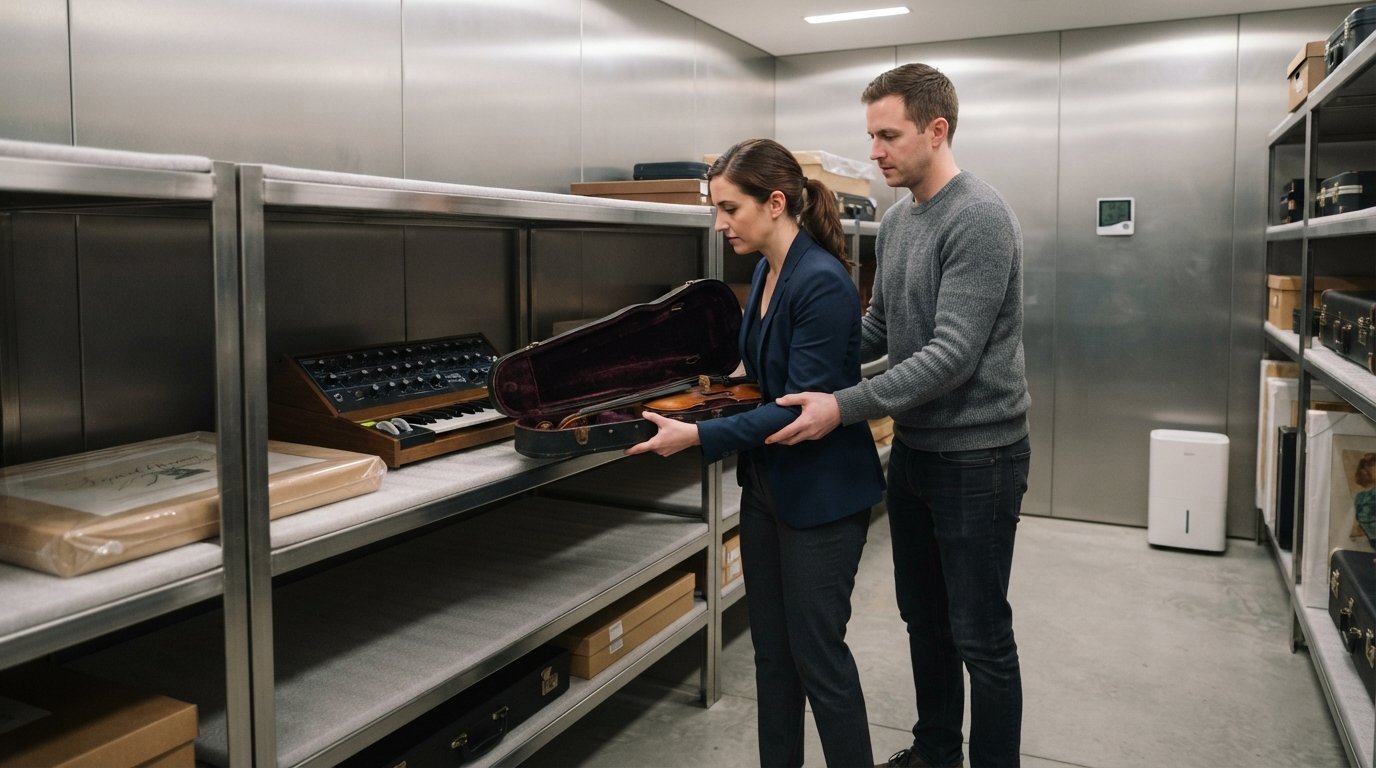
Climate Controlled Storage for Musical Instruments and Art
Protect instruments and art with stable temperature and humidity. Call (833)-484-8675 to compare climate controlled storage options for valuables.

By Lisa Anderson
Your grandmother's 1920s violin. A signed lithograph you bought at auction. A vintage analog synthesizer that still works perfectly. These items share more than sentimental value: they are highly sensitive to their environment, and a few weeks in the wrong conditions can cause damage that costs thousands to reverse, or cannot be reversed at all. That is why climate controlled storage for musical instruments and art has become a standard recommendation among collectors, musicians, galleries, and appraisers, and why understanding how it works can save you from a very expensive mistake.
Whether you are relocating across the country, downsizing, renovating your home, or simply running out of safe space, the storage decision you make will directly affect the condition of your valuables. This guide explains what climate control actually means, why instruments and artwork react so dramatically to temperature and humidity swings, and how to choose a facility that treats your collection with the care it deserves.
What Climate Controlled Storage Actually Means
Climate controlled storage is not a marketing phrase for a clean unit. It refers to a space where temperature and often humidity are actively managed within a defined range, typically using HVAC systems, dehumidifiers, and continuous monitoring. A true climate controlled facility generally maintains temperatures between 55 and 78 degrees Fahrenheit and relative humidity between 40 and 55 percent, though the exact targets vary by facility and by what is being stored.
This is different from what many people assume. A standard storage unit in a well-built building might stay cool in winter and warm in summer, but it swings with the outside weather. A climate controlled unit resists those swings. Some facilities go further with "humidity controlled" spaces that hold moisture levels steady even when outdoor humidity spikes to 90 percent in summer or drops to 15 percent in winter. For fine art and wooden instruments, that distinction matters enormously.
It helps to understand the three tiers of storage you will encounter:
- Standard drive-up units: no environmental control, temperatures track outdoor conditions.
- Interior climate controlled units: heated and cooled, usually in a fully enclosed building.
- Humidity controlled and museum-grade storage: precise temperature plus active humidity regulation, sometimes with individual monitoring and security beyond the standard gate code.
When you request quotes, ask specifically which tier a facility is offering. A unit described as "climate controlled" that only runs a heater in winter is not adequate for a cello, an oil painting, or a collection of vintage comic art.
Why Instruments and Artwork Are So Vulnerable
Musical instruments and fine art are among the most environmentally sensitive objects people own. Wood, canvas, paper, varnish, glue, and strings all absorb and release moisture as humidity changes, and they do not do so at the same rate. When a violin top expands slightly while its glue joints and varnish do not, stress builds up. Over time, that stress produces cracks, warping, and seams that separate.
Paintings react in a similar way. Canvas expands and contracts with humidity, while the paint layer on top responds more slowly. The result can be cupping, flaking, and fine cracks known as craquelure, which conservators can sometimes stabilize but rarely fully erase. Paper-based works, including prints, photographs, and lithographs, are even more fragile: high humidity encourages mold and foxing, while very dry air makes paper brittle and prone to tearing.
Temperature adds another layer of risk. Heat accelerates chemical reactions, which means varnish darkens and paper yellows faster in warm storage. Cold is generally kinder to art, but freezing temperatures can make varnish and adhesives brittle, and rapid temperature changes cause condensation that damages surfaces. This is why sudden shifts matter as much as absolute levels: moving a painting from a 90-degree truck into a 60-degree unit can cause as much harm as months of steady warmth.
Instruments have the additional problem of tension. A guitar, violin, or piano under string tension is already storing energy in its structure. Add humidity swings and the instrument can develop a twisted neck, a sunken top, or a cracked soundboard. Pianos are especially vulnerable because of their large wooden soundboard, felt hammers, and thousands of moving parts. If a piano will sit in storage for more than a few weeks, professional piano moving and climate controlled storage should be treated as a package deal, not two separate errands.
How to Evaluate a Climate Controlled Storage Facility
Not every facility that advertises climate control delivers the same standard. Before you sign a lease, ask questions that separate genuine environmental management from marketing language. A reputable facility will answer these without hesitation, and the answers should be specific rather than vague.
Here is a practical evaluation framework you can run through in a single phone call or site visit:
- Ask for the actual temperature and humidity ranges the facility maintains, not just "climate controlled."
- Ask how those levels are monitored and whether there are alarms or backup systems if equipment fails.
- Inspect the unit itself for signs of moisture, such as musty smells, stained ceiling tiles, or rust on door frames.
- Confirm security features, including cameras, gated access, individual unit locks, and whether staff are on site.
- Ask whether the facility has experience with art, antiques, and instruments, and whether they allow you to insure high-value items.
The answers to these questions tell you more than any brochure. A facility that tracks humidity with data logs and has a generator backup is operating at a different level than one that simply runs air conditioning in summer. If you are relocating at the same time, it also helps to work with movers who understand environmental sensitivity, which is why many collectors start by reviewing a complete guide to climate controlled storage movers before booking anything.
For broader home projects that involve construction dust, paint fumes, or open walls, it is worth coordinating with trusted local contractors before your valuables go into storage. Dust and solvent vapors are their own kind of threat, and sequencing renovation work correctly protects both your collection and your home. Services like Contractor.Homes connect homeowners with pre-vetted local professionals for remodeling, HVAC, and repair work, which can be useful when you need to prepare a room, upgrade a closet, or install proper shelving before your art and instruments come back home.
Preparing Instruments and Artwork for Storage
How you pack and prepare items before they enter storage determines how well climate control can protect them. Even a perfect facility cannot compensate for a painting wrapped in newspaper or a guitar left in a damp case. Preparation is where most damage is prevented, and it is worth taking seriously even if it adds a day or two to your timeline.
For artwork, the priorities are surface protection, moisture barriers, and rigid support. Paintings should be wrapped in glassine or acid-free paper, then bubble wrap, then placed in a custom crate or a rigid box with corner protection. Never let plastic wrap touch the surface of a painting, because trapped moisture can cause mold or lift the paint. Works on paper should be stored flat in acid-free folders inside a portfolio box, and framed pieces should be padded so the glass does not press against the art.
For instruments, the rules are slightly different. String instruments should have their strings slightly loosened to reduce tension, but not so much that the bridge or sound post shifts. Pianos should be professionally prepared and ideally moved and stored by specialists. Woodwinds and brass should be cleaned, dried thoroughly, and stored with their cases slightly open if possible to allow air circulation. Guitars benefit from being stored in hard cases with a humidity pack, but if the storage unit itself is properly humidity controlled, that pack is a supplement rather than a crutch.
A simple checklist for instrument storage looks like this:
- Clean and dry every instrument before casing it, including the inside of woodwinds.
- Loosen string tension slightly on violins, guitars, and similar instruments.
- Remove batteries from electronic instruments, amplifiers, and effects pedals.
- Use hard cases, not gig bags, for anything valuable or fragile.
- Label every case with contents, owner name, and any handling instructions.
Documentation is also part of preparation. Photograph each item, note any existing scratches or flaws, and keep appraisals and receipts in a separate folder. If something is damaged in storage, that record is what supports an insurance claim.
Insurance, Valuation, and Documentation
Climate controlled storage reduces risk, but it does not eliminate it. Fire, water intrusion from a burst pipe, theft, and accidental damage are still possible, and standard renter's or homeowner's policies often cap coverage for items in storage. Before you move anything into a unit, call your insurer and ask three questions: what is covered, what is excluded, and what documentation is required for a claim.
Fine art and high-value instruments frequently need a rider or a separate scheduled policy. Insurers usually want a professional appraisal, photographs, and proof of secure storage. A climate controlled facility with cameras, gated access, and individual alarms makes that conversation easier and can lower premiums. Conversely, storing a $20,000 violin in a non-controlled unit may void coverage entirely, because the insurer can argue that you failed to take reasonable care.
Keep a digital inventory with photos, serial numbers, purchase dates, and appraised values. Store a copy in the cloud and a copy with a trusted friend or attorney. If you are moving long distance, ask whether your moving company offers full-value protection during transit and confirm how it interacts with your storage coverage. The gap between transit coverage and storage coverage is where many claims fall apart, so close it deliberately rather than discovering it after a loss.
Costs, Contracts, and What to Watch For
Climate controlled storage costs more than standard storage, typically 20 to 50 percent more per month, and premium art storage can cost several times that. For a 10x10 climate controlled unit, expect monthly rates that vary widely by region, from around $150 in smaller markets to $400 or more in major cities. Humidity controlled and museum-grade spaces are priced higher still, sometimes on a per-item basis.
Watch for contracts that raise rates after an introductory period, require long notice to vacate, or prohibit certain items without saying so clearly. Ask about access hours, because some facilities limit entry to business hours, which can be inconvenient if you need to retrieve an instrument for a performance. Confirm whether the unit is truly inside a controlled building or in a semi-controlled annex. And read the fine print about liability: most storage leases limit the facility's responsibility to a small dollar amount per square foot unless you purchase additional coverage.
If you are coordinating storage with a move, bundling services usually saves money and reduces handling. Movers who pack, transport, and place items directly into a climate controlled unit minimize the number of times your belongings are touched, and each touch is a chance for damage. When you request quotes, describe your collection clearly: the appraised value, the number of instruments or framed pieces, and the environmental requirements. Providers who work with collectors regularly will know exactly what to ask and what to recommend.
Practical Takeaways for Collectors and Musicians
The single most important decision you will make is the facility itself. A well-run climate controlled unit with stable humidity, good security, and transparent management will protect your instruments and art far better than a cheap unit with unpredictable conditions. Visit in person, ask hard questions, and trust your nose: a musty smell is a warning sign that no thermostat reading can override.
Second, prepare properly. Clean, dry, case, wrap, and document everything before it goes into storage. Third, insure deliberately. Confirm coverage, keep appraisals current, and store your inventory in more than one place. Fourth, plan for retrieval. Know how you will get items out, whether you can access them during the lease, and how you will transport them safely when the time comes.
Finally, remember that climate control is a tool, not a substitute for attention. Even in the best facility, check on high-value items periodically, especially after extreme weather. A quick visit every few months can catch a small problem, a loose hinge, a hint of mold, a change in humidity, before it becomes an expensive one. Your instruments and art have survived decades or generations to reach you. With the right storage, they will survive many more.